Understanding the ion meaning in text conversations comes down to reading the rest of the sentence. In casual text and online slang, “ion” can mean “I don’t.” It is an informal phonetic spelling of how the phrase sounds in fast, casual speech. You will often see it in phrases like “ion know” or “ion care.”
“ION” can stand for “In Other News,” especially as a topic-transition phrase. People use it as a transition phrase to change the subject in informal written conversation.
Context, including sentence structure and topic flow, can help distinguish the intended meaning. It is also completely different from the science term ion, which refers to an atom or group of atoms that carries a positive or negative electric charge after gaining or losing electrons.
| If you see this pattern… | It usually means… | Quick Example |
| ion + verb phrase | “I don’t” | “ion know” = “I don’t know” |
| ION at the start of a new topic | “In Other News” | “ION, did you see the movie?” |
| Science class / technical chat | Charged particle | “The sodium ion has a positive charge.” |
What Does “Ion” Mean in a Text Message?
In texting and online writing, “ion” may be used for “I don’t,” while “ION” may also mean “In Other News.”
The most common meaning: “I don’t”
Most of the time, “ion” is a phonetic spelling for “I don’t.” In some informal speech varieties, “I don’t” may be pronounced in a way that the spelling “ion” represents in writing. Dictionary.com dates internet writing uses of ion for “I don’t” and ION for “In Other News” to the 2000s.
Here is how common phrases translate into standard English:
- “ion know” translates to “I don’t know.”
- “ion care” translates to “I don’t care.”
- “ion want to go” translates to “I don’t want to go.”
- “ion see it” translates to “I don’t see it.”
The second meaning: “In Other News”
ION can stand for “In Other News” and function as a topic-transition phrase. Text writers use this to switch topics quickly or jump to a completely new thought.
- Example: “ION, are you still coming over tonight?”
When “ion” is followed by a verb phrase, it is often interpretable as “I don’t,” as in “ion know.”
The third meaning: the science term
In chemistry, an ion is an atom or group of atoms with a positive or negative electric charge resulting from the loss or gain of one or more electrons. In a chemistry or technical context, “ion” has its scientific meaning; in casual online slang, it may instead represent “I don’t.”
In one sentence: In casual texting, ion can mean “I don’t”; ION can also mean “In Other News.” Context determines the intended reading, and neither has anything to do with science.
How to Tell Which “Ion” Meaning Someone Intended
Because one small word has two slang meanings, reading the surrounding text is the best way to avoid a mix-up.
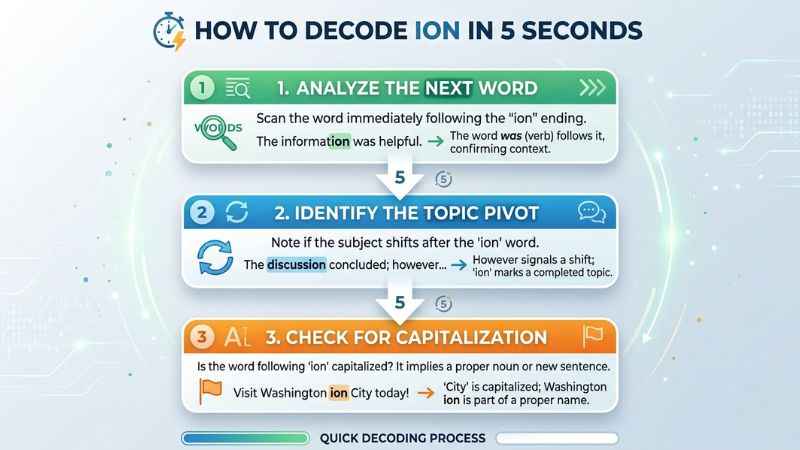
1. Check the words immediately after it
Look at the word right after “ion.” If it is a verb or action phrase, the sender means “I don’t.”
- “ion play that” = “I don’t play that.”
- “ion feel like it” = “I don’t feel like it.”
- “ion understand” = “I don’t understand.”
2. Check whether the message changes subjects
If “ion” appears at the start of a message, followed by a comma or a complete topic pivot, it means “In Other News.”
- “ION, that reminds me—did you submit the form?”
- “ION, how did your test go today?”
3. Treat capitalization as a clue, not proof
Writers often use lowercase ion for “I don’t” and uppercase ION for “In Other News,” though informal capitalization can be inconsistent. Always rely on sentence structure first.
4. Read the relationship and tone
Tone depends heavily on your relationship with the sender and the topic. With close friends, “ion care” might just be a relaxed way of saying you have no preference. In an argument, that same phrase can sound sharp or dismissive.
Quick 3-Step Context Check:
- Is there a verb right after “ion”? (Yes = “I don’t”)
- Does the rest of the text start a new topic? (Yes = “In Other News”)
- Are you texting a friend or reading a science textbook? (Friend = Slang / Textbook = Chemistry)
| Signal | More likely “I don’t” | More likely “In Other News” |
| Sentence position | Beginning of a statement | Standalone opener or followed by a comma |
| Next word | Verb / action phrase | New topic or question |
| Main function | Negating an action or feeling | Changing the subject |
| Real example | “ion understand” | “ION, did you watch the game?” |
“Ion” Examples in Text, DMs, and Comments
Seeing the word inside a full sentence makes translating it easy.
Common “I don’t” examples
Here is how “ion” translates in everyday conversations:
| Text Message | Standard English | Likely Tone |
| “ion know fr” | “I really don’t know.” | Casual uncertainty |
| “ion care what they said” | “I don’t care what they said.” | Blunt or protective |
| “ion think that’s true” | “I don’t think that’s true.” | Gentle disagreement |
| “ion got time today” | “I don’t have time today.” | Informal refusal |
| “ion want no drama” | “I don’t want any drama.” | Setting a clear boundary |
| “ion see the problem” | “I don’t see the problem.” | Confusion or debate |
Common “In Other News” examples
- “ION, I finally got the job!” (Shares exciting news)
- “ION, are we still meeting later?” (Brings the chat back on track)
- “ION, that movie was actually good.” (Starts a new opinion topic)
What “ion” can imply without saying it
Using “ion” shows that the conversation is highly informal. It signals comfort, brevity, and relaxed language between friends.
Tone Tip: Do not overread a short answer. A text like “ion know” is often just fast typing, not a sign that someone is angry with you.
What Does “Ion” Mean on Snapchat, TikTok, Instagram, and WhatsApp?
The core meaning of “ion” does not change from one app to another. Context and sentence structure matter much more than the platform you are using.
Snapchat and WhatsApp
Snapchat and WhatsApp both support private and group messaging, among other communication features. Ion is used in informal online chats and text messages.
The term can appear in social-media posts, comments, and chats. It is common in short reactions, like “ion even like that color” under a fashion post.
TikTok
The slang term may appear in informal social-media comments and reactions.
| Platform | Common Placement | Example Usage |
| Snapchat & WhatsApp | Private chats, quick snaps | “ion feel like going out” |
| DMs, post comments | “ion see why everyone is mad” | |
| TikTok | Public video comments | “ion know how you pulled that off” |
Is “Ion” Gen Z Slang? Language, Origin, and Respectful Use
While popular online, calling “ion” strictly “Gen Z slang” leaves out important language history.
Why “Gen Z slang” is an incomplete label
Social media algorithms make slang visible to millions quickly. Younger users adopt these terms online, but labeling “ion” as Gen Z slang ignores where phonetic spellings actually come from.
AAVE context and phonetic writing
Dictionary.com describes ion as a Black slang rendering of “I don’t.” The spelling ion can represent an informal spoken pronunciation of “I don’t” in some contexts.
When adopting informal language online, it helps to be aware of its cultural roots. Avoid using slang excessively or out of character just to match an online trend.
Is it an abbreviation or an acronym?
- “Ion” is an informal written rendering of “I don’t.” It mimics real-world speech sounds rather than taking the first letter of each word.
- “ION” meaning “In Other News” is an acronym. Each letter represents a distinct word.
When to Use “Ion”—and When Not To
Knowing when to use informal terms prevents awkward communication mistakes.
Good contexts for “ion”
- Casual text chats with close friends.
- Casual DMs on social media.
- Public comments on funny videos, memes, or informal posts.
Contexts to avoid
Avoid ion in most formal or professional messages unless you are quoting, analyzing, or intentionally using an established informal brand voice. Avoid it in:
- Job applications and cover letters.
- Emails to teachers, bosses, or clients.
- Workplace chat channels when clarity, professionalism, or an unfamiliar audience matters.
- Formal customer service requests.
Instead, use standard English phrases like I don’t know, I am not sure, or I prefer not to.
Can “ion” sound rude?
It can sound abrupt if sent as a single word or paired with blunt statements like “ion care.” Additional context may help clarify tone, but recipients can interpret wording and emojis differently.
| Casual Slang | Clearer & Kinder Alternative |
| “ion care” | “I don’t have a preference, whatever you pick works!” |
| “ion want to” | “I don’t think I’m up for it today, but thanks for asking!” |
| “ion know” | “I’m not entirely sure, let me check.” |
Related Slang: “Ion,” “Ionk,” “Ions,” “IDK,” and “I Ain’t”
Online shorthand includes several terms that look or sound similar.
“Ionk”
Ionk is internet slang used to mean “I don’t know.”
“Ions”
The word “ions” can simply be the plural of the scientific term (multiple charged atoms).
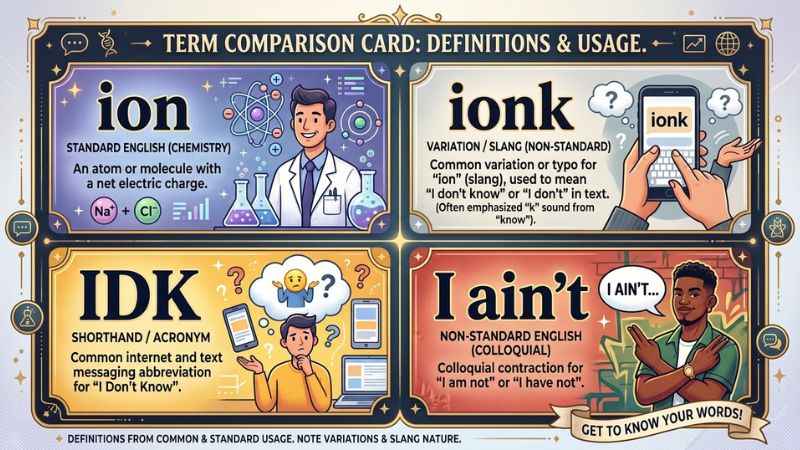
Comparing common negative terms
| Term | Meaning | Formality | Primary Usage |
| ion | I don’t | Very informal | Texting, social media |
| ionk | I don’t know | Extreme shorthand | Quick text replies |
| IDK | I don’t know | Informal acronym | Standard texting slang |
| I ain’t | Ain’t can mean “am not,” “is not,” “are not,” “has not,” or “have not,” depending on context. | Informal and nonstandard in formal edited English | Conventional form in some dialects and speech communities |
| I don’t | Standard negation | Professional / Standard | All settings |
FAQs About “Ion” Meaning in Text
Does “ion” always mean “I don’t”?
No. While “I don’t” is a common meaning in texting, uppercase “ION” often stands for “In Other News.” In science settings, it refers to an atom or group of atoms with an electrical charge.
What does “ION” stand for in a text?
When capitalized, “ION” usually stands for “In Other News.” Writers use it at the beginning of a message to transition to a new topic.
What does “ion know” mean?
“Ion know” is standard slang for “I don’t know.” The word “ion” acts as a phonetic stand-in for “I don’t.”
What does “ion” mean from a girl or a guy?
The slang definitions are not inherently gender-specific; interpret the message from its wording and context. It reflects casual, fast typing.
Is “ion” rude?
The word itself is not rude, but short responses like “ion care” can feel blunt. Additional context may help clarify tone, but recipients can interpret wording and emojis differently.
How do you pronounce “ion” as slang?
As slang, ion is generally pronounced like the scientific word ion: “EYE-un.”
What should I reply when someone says “ion”?
Reply just as you would to “I don’t.” For example, if someone texts “ion know,” you can answer with the information they need or suggest looking it up together.
Does “ion” mean the same thing on Snapchat, TikTok, Instagram, and WhatsApp?
The meanings can be understood similarly across social platforms, but the intended meaning still depends on the sentence and the community using it.
What to Do Next
The next time you receive a text with “ion,” look at the very next word. If ion is followed by a verb phrase, try reading it as “I don’t”; then check whether the full sentence makes sense. If you are replying in a work chat or professional email, skip the shorthand entirely and stick to standard English.
You May Also Like: What Does GC Mean? Group Chat, Good Call, and Other Uses

Joseph Quinn is the founder and editor of Punspa, a technology-focused website covering technology, website reviews, internet terms, and other things worth figuring out online. He writes and edits the site’s technology and web content, with a focus on clear, useful explanations. He also enjoys humor and wordplay, which occasionally leads him to write a pun-related article just for the fun of it.