In ecommerce, C2C commonly means consumer-to-consumer, a business model where individuals buy and sell directly to each other using an online marketplace. However, in U.S. recruiting and staffing, C2C commonly means corp-to-corp (or corporation-to-corporation), a contract arrangement between two companies. In texting, C2C stands for cam-to-cam.
Jump to your context:
- Ecommerce and Marketplaces
- Job Postings and Contracts
- Texting and Other Meanings
What Does C2C Mean?
C2C is an acronym used across business, recruiting, and online chat. Because the acronym has several distinct uses, you must look at the surrounding words to know which definition applies.
C2C Meaning by Context
| Context | Meaning | Typical Clue Words | Real-World Example |
| Ecommerce | Consumer-to-Consumer | Marketplace, listing, seller rating, cart, checkout | Buying a used bike on eBay |
| Jobs | Corp-to-Corp | Hourly rate, W-2, 1099, recruiter, LLC, S-Corp | An IT consultant billing a client through their own business entity |
| Chat | Cam-to-Cam | Video call, webcam, stream, live | A mutual video chat session |
| Crafting | Corner-to-Corner | Pattern, yarn, stitch, graphghans | Crocheting a blanket diagonally from corner to corner |
C2C in Ecommerce: Consumer-to-Consumer Explained
C2C ecommerce is a model in which individual consumers buy and sell goods, and sometimes services, directly with one another—typically via an online platform. Instead of buying directly from a retail store, the buyer transacts with another individual through an online marketplace that provides payment processing, search tools, and user ratings.
How a C2C Marketplace Works
C2C transactions do not mean there is no middleman. A marketplace may connect buyers and sellers and may provide tools such as listings, messaging, payments, ratings, and dispute processes.
- Listing: The seller creates an account, uploads photos, adds a description, and sets a price.
- Discovery: The buyer searches the marketplace, compares listings, and reads seller reviews.
- Agreement: The buyer pays through the platform or agrees on a meeting time for local pickup.
- Processing: Depending on the platform and transaction type, the platform may process payment, deduct selling fees, provide messaging or labels, and delay payout under its payment rules.
- Completion: The buyer receives the item, leaves feedback, and the platform releases funds to the seller.
C2C Examples

Many top online platforms run on a C2C or hybrid model.
| Platform | Typical Transaction | Platform’s Role |
| eBay | Used electronics, collectibles, and pre-owned clothing | eBay manages payments, may place holds in specified cases, offers protections subject to policy conditions, and charges seller fees. |
| Facebook Marketplace | Local household items, furniture, and vehicles | Facebook Marketplace provides discovery and messaging for local transactions and, where eligible and available, supports checkout and shipping. |
| Poshmark & Depop | Secondhand clothing and accessories | Poshmark offers prepaid labels and authentication for eligible items/orders. Depop supports seller payments and may offer shipping-label tools depending on market and shipping method. |
| Airbnb | Peer-to-peer property rentals | Airbnb connects hosts and guests and processes bookings. Damage-related claims can be handled through its Resolution Center; security deposits are limited to select, properly disclosed cases. |
Note: Platforms like Etsy started primarily for individual creators, but many sellers now operate full-scale commercial businesses alongside individual artisans.
How C2C Platforms Make Money
Many C2C marketplaces do not own the items listed; instead, they facilitate transactions between sellers and buyers. They generate revenue through service and transaction fees:
- Transaction fees: Taking a percentage of the final sale price (take rate).
- Payment processing fees: Payment-processing fees may be charged separately or incorporated into marketplace fees, with structures varying by platform and location.
- Listing & promo fees: Charging sellers to boost visibility in search results.
- Shipping & services: Some platforms generate additional revenue from optional services such as promoted listings, shipping tools, or authentication services, where offered.
C2C vs B2C vs B2B: What Is the Difference?
Understanding how C2C compares to other commerce models makes it easier to spot who holds the product inventory and who bears the responsibility for customer service.
| Model | Who Sells | Who Buys | Platform / Company Role | Main Customer Trust Challenge |
| C2C | Consumer | Consumer | A C2C platform may provide marketplace tools and, in some cases, payment protection or dispute processes | Item condition and seller honesty |
| B2C | Business | Consumer | In B2C, a business sells to consumers and is generally the commercial seller responsible for the customer relationship, though inventory ownership and fulfillment may be outsourced | Brand reputation and pricing |
| B2B | Business | Business | In B2B, one business sells products or services to another business; wholesale goods and enterprise software are common examples | System integration and contract terms |
C2C can be useful for reselling personal items, finding niche or collectible goods, and comparing prices for pre-owned products.
Benefits, Risks, and Safe C2C Transactions
C2C marketplaces can expand access to secondhand inventory, while buyers and sellers should understand the platform’s protections, return rules, payment procedures, and dispute process.
Benefits of the C2C Model
- Lower prices: Buyers often pay less than retail prices for pre-owned goods.
- Circular economy: Unwanted items find new homes instead of ending up in landfills.
- Access to rare items: Collectors can source out-of-print, antique, or vintage items.
- Low barrier to entry: Anyone can turn extra personal belongings into cash without starting a formal store.
Risks and Limitations
- Uneven item quality: Used items may arrive damaged, heavily worn, or misdescribed.
- Scams and fraud: Potential risks include fake listings, counterfeit items, and off-platform payment scams.
- Limited returns: Return rights can differ from standard retail purchases and depend on platform policy, the seller’s terms, and applicable law.
C2C Safety Checklist for Buyers and Sellers
| Buyer Action Items | Seller Action Items |
| Check the seller’s account age and feedback history. | Take clear photos of all item defects and write honest details. |
| For transactions that offer platform checkout and protection, keep payment on-platform to preserve any available protections. For local transactions, use a payment method you understand and verify the item before paying. | Ship with tracking numbers and keep proof of delivery. |
| For transactions that offer platform checkout and protection, keep payment on-platform to preserve any available protections. | Read platform return and fee policies before listing high-value goods. |
| Inspect local pickup items thoroughly before handing over money. | For local exchanges, consider a public, well-lit location and follow local safety guidance; some communities offer designated exchange locations. |
What Does C2C Mean in Jobs and Recruiting?
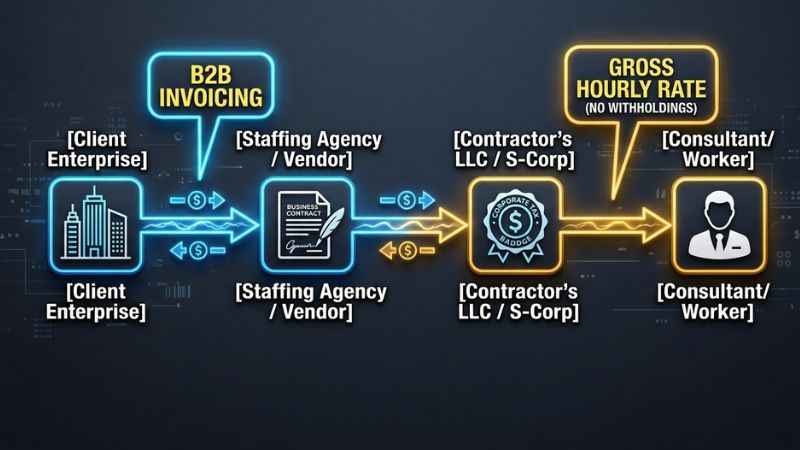
In U.S. recruiting and staffing, C2C commonly means corp-to-corp (or corporation-to-corporation). A business contracts with another business entity—often a contractor’s company, sometimes through a staffing agency or vendor—rather than employing the worker directly.
How a Corp-to-Corp Arrangement Works
Under a C2C arrangement, the contracting business typically pays the contractor’s business entity, which may be structured in different ways. The payer may be the end client, a staffing agency, or another vendor. Independent contractors and their businesses generally handle their own tax compliance and business expenses; benefits and insurance arrangements depend on the business, contract, and jurisdiction.
Legal Disclaimer: Tax and employment classification laws vary by region. The following comparison is for educational purposes and reflects general U.S. contracting structures. Consult an accountant or attorney for specific guidance.
C2C vs W-2 vs 1099
| Feature | C2C (Corp-to-Corp) | 1099 (Independent) | W-2 (Employee) |
| Contracting Party | Worker’s Business Entity | Individual Worker | Individual Worker |
| Payee | Business Bank Account | Personal Name / Sole Proprietor | Personal Name |
| Tax Withholding | The client generally does not withhold employee payroll taxes for a C2C vendor; the contractor’s business remains responsible for its own tax and payroll compliance as applicable | For an independent contractor, the payer generally does not withhold employment taxes; the contractor is generally self-employed and may owe income and self-employment taxes | For employees, employers generally withhold applicable income and payroll taxes and remit employer payroll taxes, subject to applicable law |
| Benefits | Employee benefits are generally not provided by the client unless the contract states otherwise; the contractor’s business arranges any desired benefits or insurance | Independent contractors generally do not receive employee benefits, unless a contract or applicable program provides otherwise | Employees may be eligible for employer-sponsored benefits and paid leave, subject to employer plan rules and applicable law |
| Required Entity | A C2C arrangement generally requires a business entity or business vendor relationship acceptable to the client; the exact legal and tax structure varies. An LLC can have different federal tax treatment, including disregarded-entity treatment for a single-member LLC | An independent contractor may operate as a sole proprietor or through a business entity; the required structure depends on the client, contract, and jurisdiction | None |
| Best For | Experienced consultants with existing business structures | Freelancers taking short project-based work | Workers seeking steady income, benefits, and workplace protections |
What “C2C Rate” or “All-Inclusive C2C” Usually Means
A quoted C2C rate typically refers to the contract rate payable to the contractor’s business, subject to the agreement’s terms, agency structure, expenses, and applicable taxes. “All-inclusive” commonly indicates that the stated rate is intended to cover the contractor’s expected costs, but the contract must specify whether travel, equipment, expenses, insurance, and other items are reimbursable. A C2C rate often needs careful comparison with a W-2 offer because contractors may bear costs that an employer otherwise covers. Whether a higher rate is needed depends on the full compensation package, tax treatment, business costs, and contract terms.
Other Meanings of C2C
C2C also has recognized meanings in online chat and crochet.
C2C in Texting and Online Chat
In some messaging and online-chat contexts, C2C means cam-to-cam, referring to a two-way webcam/video chat. Always use safe online practices and avoid sharing personal details with unknown video chat partners.
C2C in Crochet
In crochet, C2C means corner-to-corner: a technique worked diagonally from one corner of a project to the opposite corner. It is a popular method for creating textured blankets with pixelated designs.
Frequently Asked Questions About C2C
What does C2C stand for?
C2C most commonly stands for consumer-to-consumer in business or corp-to-corp in recruiting. It can also stand for cam-to-cam in chat or corner-to-corner in crochet.
Is C2C the same as consumer-to-consumer?
Consumer-to-consumer, also called customer-to-customer, refers to transactions or interactions between individual consumers, often facilitated online by a marketplace.
Is eBay a C2C marketplace?
eBay is a long-established global marketplace that has connected buyers and sellers since 1995. eBay connects buyers with both individual and business sellers.
What does C2C mean in a job posting?
In a U.S. job or staffing context, C2C usually signals that the role is offered through a business-to-business contracting arrangement, often involving the contractor’s company and possibly a staffing agency or vendor.
Is C2C better than W-2 or 1099?
C2C is not inherently better or worse; it depends on your business setup. A contractor’s business may deduct allowable business expenses under applicable tax rules, and contractors may negotiate rates based on their costs and market conditions, but it requires managing your own legal entity, insurance, and taxes without employer-funded benefits.
What is the difference between C2C and B2C?
In C2C (consumer-to-consumer), individuals trade with each other using a third-party platform. In B2C, a business sells products or services directly to individual consumers; inventory ownership and fulfillment arrangements vary.
The Bottom Line: Which C2C Meaning Applies to You?
To instantly identify which C2C meaning you need, take this next step based on where you saw the term:
If you are reading a chat or craft forum: Check the surrounding post for context clues like “webcam” (cam-to-cam) or “yarn/pattern” (corner-to-corner).
If you are buying from or selling to another individual through an app: You may be using a consumer-to-consumer marketplace. Review platform protection rules and keep your payments on-platform.
If a recruiter uses the term C2C in a role description: It usually refers to a corp-to-corp contracting opportunity in U.S. staffing. Before accepting a C2C engagement, confirm the client or agency’s entity, insurance, invoicing, payment, and compliance requirements; obtain professional advice where needed.
You May Also Like:
RCTA Meaning: Rear Cross Traffic Alert in Cars vs. TikTok Slang
MSO Meaning: Healthcare, Vehicle Titles, and Other Common Definitions

Joseph Quinn is the founder and editor of Punspa, a technology-focused website covering technology, website reviews, internet terms, and other things worth figuring out online. He writes and edits the site’s technology and web content, with a focus on clear, useful explanations. He also enjoys humor and wordplay, which occasionally leads him to write a pun-related article just for the fun of it.