Jamaican slang refers to informal words and expressions derived from Jamaican Patois (also called Patwa), an English-based creole language. While rooted in daily island life, these phrases appear globally in reggae music, dancehall culture, and everyday conversation.
If you are planning a trip to Jamaica or listening to your favorite dancehall tracks, learning key terms helps you communicate smoothly and avoid awkward mistakes. Use this simple chart to learn the most popular expressions:
| Phrase | Meaning | Tone / Setting | Best Use |
| Wah gwaan | What’s up? / How are you? | Informal / Friendly | Everyday greeting |
| Irie | Everything is good / Peaceful | Casual / Positive | Expressing contentment |
| Bless up | Have a blessed day | Friendly / Warm | Greeting or goodbye |
| Mi deh yah | I am here / Doing okay | Casual | Response to “Wah gwaan” |
| Likkle more | See you later | Casual | Say goodbye |
| Walk good | Safe travels / Take care | Warm / Caring | Traditional farewell |
| Bredren | Male friend / Brother | Friendly | Referring to a pal |
| Nyam | To eat | Casual | Talking about food |
What Is Jamaican Slang—and How Is It Different from Patois?
Direct Answer: Jamaican Patois (Patwa) is a complete, standalone Creole language with its own grammar system and structure. Jamaican slang refers only to the trendy, informal vocabulary used inside that language.
Many visitors assume Patois is just “broken English” or a collection of casual street words. Linguists classify Patois as an English-based Creole language. It developed during the 17th century when enslaved Africans combined English vocabulary with West African grammatical structures.
Because Patois has its own rules for verb tenses and sentence order, it functions as a full language. Slang terms change with pop culture and dancehall trends, but the core Patois language stays constant. Treating Patois as proper language rather than simple street talk shows respect for Jamaican history.
Essential Jamaican Slang Phrases for Beginners (With Meanings)
Mastering basic expressions helps you connect with locals and understand music lyrics without confusion.
Greetings and Everyday Responses
Greetings are central to Jamaican culture. Walking past someone without a polite word is considered rude.
| Phrase | Literal Meaning | Common Meaning | Tone | Example Sentence |
| Wah gwaan? | What is going on? | What’s up? | Informal | “Wah gwaan, my friend?” |
| Irie | All right / Free | Everything is fine | Casual | “Everything is irie today.” |
| Ya mon | Yes, man | Yes / Absolutely | Friendly | “You ready to go?” “Ya mon!” |
| Mi deh yah | I am right here | I’m doing fine | Casual | “How yuh stay?” “Mi deh yah.” |
| Likkle more | Little more | See you later | Informal | “I must leave now, likkle more.” |
| Walk good | Walk well | Safe travels | Warm | “Walk good on your way home.” |
| Bless up | Bless up | Wish you well | Respectful | “Bless up, have a great day.” |
| Yow | Hey | Hey there | Casual | “Yow, look at that over there!” |
| How yuh stay? | How do you stay? | How are you doing? | Informal | “Long time no see, how yuh stay?” |
| Weh yuh a seh? | What are you saying? | What are you up to? | Casual | “Weh yuh a seh tonight?” |
People and Relationships
Jamaicans use specific nouns to address family, friends, and romantic partners.
| Term | Refers to | Tone / Context | Example Sentence |
| Bredren | Male friend | Warm / Respectful | “That guy is my bredren.” |
| Sistren | Female friend | Warm / Respectful | “Give my love to the sistren.” |
| Gyal | Girl or woman | Casual | “The gyal is standing over there.” |
| Bwoy | Boy or guy | Casual | “That bwoy can run fast.” |
| Yute | Youth or child | Casual | “The yutes are playing outside.” |
| Pickney | Young child | Informal / Family | “Keep an eye on the pickney.” |
| Gyalis | Ladies’ man / Player | Informal | “He thinks he is a real gyalis.” |
Actions, Feelings, and Descriptions
These descriptive words help you explain actions, personalities, and daily moods clearly.
| Term | Meaning | Tone | Example Sentence |
| Nyam | To eat food | Casual | “Come let us nyam some food.” |
| Criss | Cool / Looking good | Positive | “Your new car looks criss.” |
| Mash up | Broken or ruined | Neutral | “The storm will mash up the road.” |
| Stush | Snobbish or stuck-up | Critical | “She did not say hello, she is too stush.” |
| Boasy | Showy or boastful | Playful / Critical | “He bought new shoes and acts boasy.” |
| Faas | Nosey or meddling | Critical | “Don’t be faas in my business.” |
| Labrish | Gossip / Idle chat | Casual | “Stop the labrish and do your work.” |
| Dutty | Dirty or messy | Neutral | “Wash those dutty pants.” |
| Wicked | Awesome / Amazing | Positive | “That music track is wicked!” |
| Bad | Great / Impressive | Positive | “She is a real bad dancer.” |
Pronunciation Basics: How to Sound Less Like a Tourist
Pronouncing Patois correctly relies on distinct sound rules. Understanding how letters change makes your speech sound natural.
Plaintext
English Sound: "TH" (/θ/ or /ð/)  --->  Patois Sound: "D" or "T"
Examples:
  - "This"  --->  "Dis"
  - "That"  --->  "Dat"
  - "Think" --->  "Tink"
  - "Three" --->  "Tree"
- The TH-to-D/T Shift: Patois replaces “th” sounds with hard “d” or “t” sounds. “This” becomes “dis,” “that” becomes “dat,” and “think” becomes “tink.”
- Shortened Prepositions: The word “for” softens into “fi.” For example, “This is for you” becomes “Dis a fi yuh.”
- Consonant Cluster Reductions: Words ending in consonants often drop soft sounds or simplify letter clusters. “Little” simplifies to “likkle,” where the “tl” shifts to a hard “kl.”
- Rhythm and Stress: Speech follows a distinct, melodic cadence with natural speech flow and vocal inflection.
To practice listening to natural pronunciation, consult community language hubs like JamaicanPatwah.com or LearnPatois.com.
Jamaican Slang for Tourists: Do’s, Don’ts, and Survival Phrases
Using local expressions while traveling makes interactions fun, but overdoing it can seem unnatural.
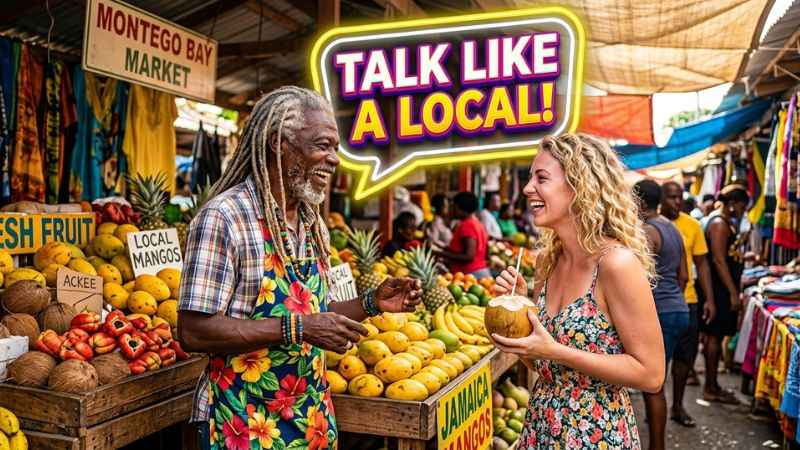
Traveler Do’s and Don’ts
- DO open conversations with a warm greeting like “Wah gwaan” or “Good morning.”
- DO respond with “Irie” when asked how you are doing.
- DO say “Thank yuh” and “Walk good” to show appreciation.
- DON’T force a fake Jamaican accent. Speak in your normal voice using the phrase.
- DON’T overuse “Ya mon.” Tourists often repeat it excessively, which can sound staged.
- DON’T use harsh local swear words under any circumstances.
Practical Survival Phrases for Visitors
| Situation | Useful Phrase | Meaning | Practical Note |
| Taking a Taxi | “How much fi go a…?” | How much to go to…? | Confirm the price before getting inside. |
| Shopping | “How much dis cost?” | How much is this? | Ask politely at local markets. |
| At a Restaurant | “Mi want nyam…” | I want to eat… | Great for ordering food at road stands. |
| Getting Directions | “Which part… deh?” | Where is… located? | Use when looking for landmarks. |
Cultural Note on Time: If a local tells you they are “soon come,” it rarely means they will arrive immediately. It expresses an intention to come later without a strict timeframe. Plan your daily schedule with this flexible timing in mind.
Words to Avoid: Jamaican Insults and “Bad Words” Explained
Warning: Patois profanity carries heavy social stigma. Avoid using terms ending in “-claat” (such as bloodclaat, pussyclaat, or bumboclaat).
While these terms often appear in uncensored reggae songs or movies, native speakers reserve them for extreme anger. The suffix -claat historically refers to old menstrual or bathroom cloths, making these words deeply offensive in daily conversation.
Using these bad words as an outsider can cause immediate offense or escalate arguments. Milder exclamations like “rahtid” signal surprise (similar to “wow”), but visitors should stick to polite, positive language to stay safe.
Modern & Music-Driven Jamaican Slang (Dancehall, Social Media)
Dancehall music and modern social media constantly create new terms. Gen Z Jamaicans and international fans update these words frequently.
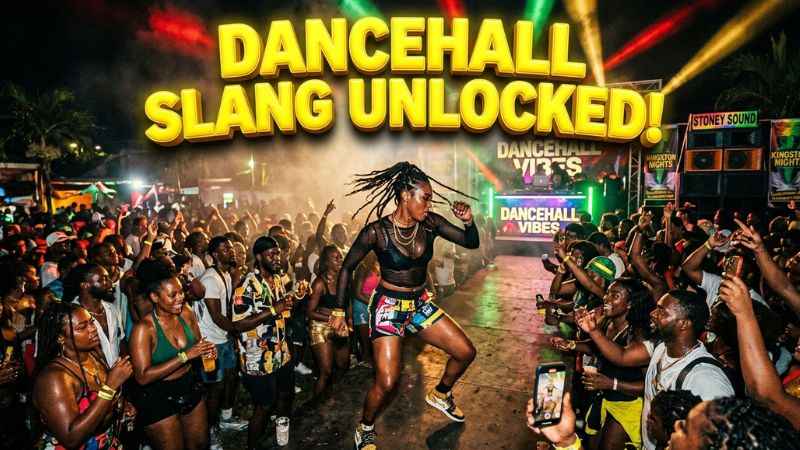
- Yard: Refers to home, your property, or Jamaica itself (e.g., “Mi going back to yard”).
- Bashment: A large street party, dance hall event, or great celebration.
- Forward: To leave, travel, or move toward a new place.
- Run tings: To take control of a situation or lead an activity.
- Rude gyal / Rude bwoy: A stylish, confident person who embraces street culture.
- Dutty: Primarily means dirty or messy; used in dancehall to describe gritty dancing styles (like the “dutty wine”) or raw drum beats.
Common Mistakes and How to Use Jamaican Slang Respectfully
Avoid these frequent mistakes when speaking with locals:
- Treating Patois like a joke: Patois is a real language with historical roots. Treat it with the same respect as French or Spanish.
- Expecting literal timing: Remember that flexible phrases like “soon come” reflect local culture, not bad punctuality.
- Over-mimicking: Trying to sound completely native right away can feel like an impression. Use local words naturally within your own accent.
Mirror the tone of the person you are talking to. If a resort worker or taxi driver speaks formal English, reply in kind. Save casual slang for informal settings where locals invite it.
FAQ: Quick Answers to Common “Jamaican Slang” Questions
How do you say “shut up” in Jamaican slang?
Commanding someone to be quiet includes expressions like “Kibba yuh mout” or “Shut yuh mouth.” “Hush yuh mouth” can also be used, though “hush” on its own often expresses sympathy or condolences.
How do you flirt in Jamaican slang?
To compliment a woman, you can say, “Yuh looking criss today” (You look great today) or call her “My girl.” Keep your tone light and polite.
How do Jamaicans say “pretty girl”?
Jamaicans often say “browning” (referring specifically to a light-skinned Black or mixed-race woman) or call an attractive woman a “pretty gyal.”
What does “licky licky” mean in Jamaican?
“Licky licky” describes someone who is greedy, grasping, or willing to fawn and debase themselves for food, treats, or favors.
Is Jamaican Patois a language or just slang?
Jamaican Patois is a recognized Creole language with established grammar. Slang consists of informal vocabulary words used within Patois.
What Jamaican words should tourists avoid?
Tourists must avoid severe profanities like bloodclaat, pussyclaat, and bumboclaat. Critical descriptors like stush (snobbish) or faas (nosy) should also be avoided when speaking to strangers to prevent sounding impolite.
How do you pronounce “wah gwaan” and “irie”?
Pronounce “wah gwaan” as wah-gwan (rhymes with “on”). Pronounce “irie” as eye-ree.
What does “bloodclaat” mean and is it offensive?
It refers historically to a soiled cloth and serves as a severe curse word. It is highly offensive and should not be used casually.
What’s the difference between “bredren” and “sistren”?
Bredren refers to a male friend or brother figure. Sistren refers to a female friend or sister figure.
What are safe Jamaican slang words for beginners?
Safe, easy words include “Wah gwaan” (greeting), “Irie” (good), “Bless up” (take care), and “Walk good” (farewell).
What to Do Next
Listen to Jamaican audio recordings or popular dancehall songs to hear these phrases spoken by native speakers. Bookmark this guide to review key greetings and survival phrases before your next trip to the island.
You May Also Like:
Drip Meaning Slang: What It Means, How to Use It, and Where It Came From (2026)
Bet Slang: What It Means, How to Use It, and Where It Came From (2026 Guide)

Joseph Quinn is the founder and editor of Punspa, a technology-focused website covering technology, website reviews, internet terms, and other things worth figuring out online. He writes and edits the site’s technology and web content, with a focus on clear, useful explanations. He also enjoys humor and wordplay, which occasionally leads him to write a pun-related article just for the fun of it.