Quick Answer: TechTrendery.com is a general-interest publishing website built on WordPress. Despite its tech-focused name, it publishes basic articles on many non-tech topics, including health, business, lifestyle, and public figures. It is not a software company. There is no publicly documented expert review or fact-checking policy.
If you came across techtrendery.com while searching for news or background research, you might wonder who runs it and whether the information is accurate. The name sounds like a dedicated technology journal. However, the site functions as an open-topic blog network.
This guide breaks down what techtrendery.com actually offers, how it compares to lookalike websites, and how to safely evaluate its content.
What Is TechTrendery.com? A Clear Definition
Key Takeaway: TechTrendery.com is an online publishing site, not a technology creator. It uses a standard WordPress setup to post short summaries across wide-ranging categories.
Not a Tech Company—It’s a Content Platform
TechTrendery.com does not build software, manufacture hardware, or offer IT consulting services. It is strictly an online content platform.
The website runs on the WordPress Content Management System (CMS). Like millions of personal blogs, it relies on template layouts to publish high volumes of text. Instead of covering deep technical updates, it posts light informational content meant for casual web searches.
Why the Name Is Misleading
The word “Tech” in the domain name causes readers to expect specialized coverage of software engineering, gadget reviews, or IT trends.
In reality, the site publishes content far outside the technology field. On any given day, its homepage may feature posts about:
- Wedding ring choices and jewelry care
- Construction tools and trailer rentals
- Public figure biographies
- Home decor and interior styling
- Everyday health and fitness tips
It is best understood as a multi-topic generalist blog that happens to carry a tech-sounding name.
The Domain Ecosystem: techtrendery.com vs. mytechtrendery.com

Several domains on the web share similar names. This creates confusion for readers trying to find official sources.
| Domain | Observed Content Focus | Status / Relationship |
| techtrendery.com | Multi-topic (Tech, Biographies, Lifestyle) | Primary focus of this review |
| mytechtrendery.com | Multi-topic with “USA” branding | No public records confirm whether these domains share ownership, operators, or content management systems. |
| thetechtrendery.com | General interest and digital trends | Relationship to techtrendery.com is unverified; no public ownership data available. |
| techtrenderys.com | Gadgets, AI tools, basic business | Alternate spelling variant |
Freshness Note: Ownership links between these domain variants remain unverified. Web publishers often buy similar domains to capture search traffic, so double-check the URL in your browser address bar.
What Topics and Content Does TechTrendery.com Publish?
Key Takeaway: TechTrendery.com covers a vast array of topics, ranging from basic software guides to lifestyle advice and heavy machinery rental tips.
Core Content Categories
The site organizes its posts into broad verticals:
- Technology & Digital Tools: Basic overviews of Artificial Intelligence (AI), SaaS tools, cybersecurity terms, and social media platforms.
- Business & Marketing: Beginner guides for Instagram marketing, online business tools, and workplace strategies.
- Biographies: Short life summaries of public figures, company founders, media personalities, and historical icons.
- Lifestyle & General Interest: Articles covering health habits, education ideas, interior design, and relationship advice.
- Industrial & Local Services: Niche informational posts about freight logistics, mobile bar rentals, and construction gear.
| Main Category | Key Topics Covered |
| Technology & AI | Software, Cybersecurity, AI Tools |
| Business & Marketing | SaaS, Instagram Agencies, Online Marketing |
| Biographies | Public Figures, Company Founders, Historical Icons |
| Lifestyle | Health, Home Design, Education |
| Industrial Services | Construction Equipment, Logistics, Rentals |
Content Format and Style
The writing uses plain language designed for quick reading rather than technical analysis. Visual elements appear to include stock photography; image licensing status is not publicly disclosed.
Content Quality Spectrum
Because the site covers so many subjects, content quality varies significantly depending on the category.
| Category Level | Risk & Quality | Best For | Caution / Recommendation |
| Biographies & Overviews | Higher Quality / Low Risk | Easy to cross-check with public facts | Good for quick background research |
| Basic Tech Explanations | Moderate Quality / Medium Risk | Sufficient for beginners | Adequate for basic concepts |
| Medical & Financial Advice | Lower Quality / High Risk | Lacks documented expert review | Verify with licensed professionals |
- Stronger Topics: General biographies and high-level marketing overviews. These articles aggregate widely available facts that are easy to verify elsewhere.
- Weaker Topics: Highly technical software guides, complex coding tutorials, and medical topics. These posts often lack detailed steps and fail to cite credentialed experts.
- Inconsistent Topics: Breaking tech news. Coverage can lag behind major outlets or rely on secondary reporting without direct links to original sources.
Is TechTrendery.com Legit and Safe to Use?
Key Takeaway: TechTrendery.com is a functional, real website secured with standard HTTPS encryption. It is safe to browse, but its claims should be double-checked before making financial or medical choices.
Legitimacy: Yes, It’s a Real Website
TechTrendery.com is an active site that posts new content regularly. It is not a fake page designed to steal credentials.
- It uses an HTTPS certificate, meaning your connection to the site is encrypted.
- Browsing the pages does not trigger automatic software downloads or security warnings.
- It operates as a standard content site likely monetized through standard web publishing methods (ads, affiliate links, or sponsored content); specific revenue model is not publicly disclosed.
But “Legit” Does Not Mean “Authoritative”
A website can be completely legal and safe to open while still lacking editorial authority. A polished layout and safe web protocols only mean the server is secure. They do not guarantee that the writer is a qualified subject-matter expert.
Safety Precautions When Visiting
- Check the address bar: Ensure you are on the intended domain and not a copycat page.
- Keep your browser updated: Use current versions of Chrome, Safari, or Firefox to block rogue pop-ups.
- Avoid downloading unknown files: Do not download PDF guides or executable files from pop-up prompts.
- Do not share personal details: Do not enter credit card details or personal identification on basic informational blogs.
- Treat text as general reading: Never use self-published web posts as a substitute for professional legal, medical, or financial counsel.
How Trustworthy Is the Information on TechTrendery.com?
Key Takeaway: The site lacks visible credentialed authors, published editorial standards, and clear fact-checking policies. Use it for general ideas, but verify critical details with primary sources.
Trust Signal Checklist for Evaluating Articles
Search engines evaluate content trust using experience, expertise, authoritativeness, and trust signals (E-E-A-T). Here is how TechTrendery.com measures up:
| Trust Signal | TechTrendery.com Status | What This Means for Readers |
| Named Author Bylines | Inconsistent | Many articles use generic terms like “Editorial Team.” |
| Author Credentials | Minimal | Little evidence showing the writer’s real-world background. Based on available About page and third-party reviews; individual article bylines are not systematically audited. |
| Publication Dates | Present on articles | Publication dates appear on articles; consistency across all pages is not independently verified. Helps you see if the information is current. |
| Source Citations | Varies | Citation practices are not publicly documented; individual articles should be evaluated for source attribution. References to official studies or data are often missing. |
| Editorial Standards | Not publicly listed | No published policies on how facts are verified. |
| Corrections Policy | None visible | No clear path for reporting or fixing mistakes. |
| Ownership Disclosure | Limited | No clear details about the parent company or owners. |
Red Flags to Watch For
When reading posts on general blogs, watch out for these warning signs:
- Claims containing statistics or pricing data that lack direct links to sources.
- Health or medical suggestions that do not cite recognized health organizations or medical journals.
- Software reviews that show no evidence of hands-on testing.
- Outdated setup guides for fast-changing tools like AI software or social media algorithms.
When to Trust vs. When to Verify
WHEN TO TRUST (Low Risk)           WHEN TO VERIFY (High Risk)
─ Casual reading                   ─ Financial investments
─ Basic definitions                ─ Health or medical symptoms
─ High-level bios                  ─ Legal regulations
─ Overview of trends               ─ Technical installations
- Safe to read for: Quick definitions, background context on public figures, or simple summaries of everyday concepts.
- Verify elsewhere for: Medical advice, financial guidance, legal rules, hardware setup steps, or breaking news.
- Better alternatives: Turn to established, specialized outlets like TechCrunch for industry updates, or Wired for deep investigative reporting.
Is TechTrendery.com a US Website? The “USA” Branding Question
Key Takeaway: While the site uses English and caters to American readers, there is no publicly verified evidence of a US physical headquarters or corporate registration.
What “TechTrendery.com USA” Actually Means
Search results sometimes connect the site with the term “USA.” In web publishing, adding “USA” to a blog’s branding often signals that the content is written in American English and targets search traffic from the United States. There is no publicly verified evidence of a US physical headquarters or corporate registration.
Why This Confusion Exists
- Domain variants: Lookalike domains like mytechtrendery.com occasionally use “USA” in their title tags.
- Search algorithms: Search engines group terms together when readers frequently search for “TechTrendery USA.”
- Automated reviews: Low-quality review sites copy descriptions from one another without checking real corporate filings.
Does Geographic Location Matter for Readers?
For basic informational articles, the site’s physical location matters very little. However, if an article covers US tax rules, local labor laws, or regional health guidelines, missing location details mean you must double-check if the advice applies to your local jurisdiction.
How to Use TechTrendery.com Effectively (and When Not To)
Key Takeaway: Use the site as an informal starting point for basic research. Switch to official databases, documentation, or field experts for decisions that carry real-world consequences.
Decision Guide: How to Process Content on TechTrendery.com
1. **Start Reading:** Open the article on TechTrendery.com.
2. **Evaluate the Topic Risk (YMYL Check):**
* Determine if the topic involves high-risk subjects like health, financial advice, legal matters, or critical software setups.
3. **Take Action Based on Risk Level:**
* **If NO (Low-Risk Topic):** Safe for casual reading, general ideas, and quick overviews.
* **If YES (High-Risk Topic):** Do not rely solely on the article. Cross-check key details across 2–3 primary sources:
* Official manuals & developer docs
* Academic databases & medical journals
* Certified or licensed professionals
Best Use Cases
- Getting a quick overview of an unfamiliar term.
- Reading a simplified summary of a public figure’s career.
- Finding broad topic ideas for general business or marketing concepts.
When to Seek Other Sources
- Technical Setup: Go straight to official software documentation (like Microsoft or Python guides).
- Health Decisions: Consult medical resources like the National Institutes of Health (NIH) or a licensed doctor.
- Financial Choices: Read advice from certified financial planners or regulated institutions.
- Academic Work: Cite peer-reviewed journals, university publications, or primary historical archives.
A Simple 3-Step Verification Process
- Isolate the main claim: Pull out the specific stat, date, or feature mentioned in the post.
- Search official databases: Query the fact using primary documentation or recognized news agencies.
- Confirm consensus: Ensure at least two independent, expert-backed sources agree on the details.
TechTrendery.com vs. Established Tech Publications
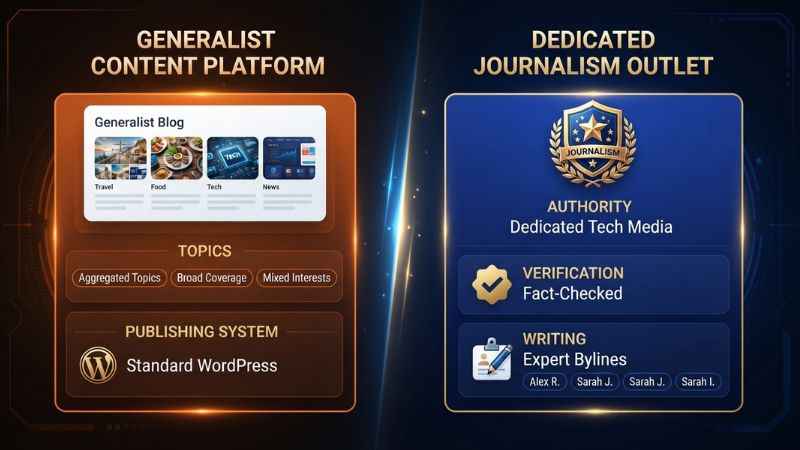
To understand where TechTrendery.com sits in the media landscape, compare it against traditional technology journalism outlets:
| Feature | TechTrendery.com | Established Tech Media (e.g., Wired, The Verge) |
| Editorial Model | Multi-topic generalist blog | Specialized technology publication |
| Writer Expertise | Frequently generic or unnamed bylines | Specialized journalists with clear beats |
| Fact-Checking | Internal/Unstated | Dedicated editorial boards and fact-checkers |
| Primary Sources | Secondary summaries and web research | Original interviews, hardware tests, leaks |
| Topic Range | Broad (Tech, Health, Lifestyle, Gear) | Focused (Tech, Science, Digital Culture) |
| Best For | Light background reads | In-depth analysis, breaking news, reviews |
Frequently Asked Questions
Is TechTrendery.com free to read?
Yes. The website is free to access and does not use a paid subscription model or paywall.
Do I need to create an account to view content?
No. All published articles are open to the public without registration or logging in.
Who owns or runs TechTrendery.com?
Public corporate registry records do not show clear ownership details for TechTrendery.com. The site includes an email contact address ([email protected]) but does not list a parent company or editorial address.
Does TechTrendery.com have expert authors?
Some articles list specific author names, but detailed professional bios, qualifications, and credentials are rarely provided. Based on available About page and third-party reviews, many posts are credited generally to an “Editorial Team”; individual article bylines are not systematically audited.
Can I cite TechTrendery.com in academic or professional work?
No. Academic institutions and professional research standards require primary sources, peer-reviewed journals, or reputable news outlets with transparent editorial oversight.
How often is the content updated?
Articles show publication dates; update frequency and consistency are not independently verified. Always check the top of individual articles to see when the information was posted.
Is TechTrendery.com safe from malware?
Yes. The site uses standard HTTPS encryption and displays no evidence of malicious code or dangerous software downloads.
Final Verdict: Should You Use TechTrendery.com?
TechTrendery.com works fine for casual browsing, light background reading, and high-level definitions. It provides easy-to-read overviews across a wide variety of daily topics.
However, because it operates as a general-interest blog without published expert reviews or primary sourcing, it should not be treated as a definitive authority.
Your Next Step: If you are researching health choices, financial steps, or complex technical setups, use TechTrendery.com only as a initial brainstorming tool. Always cross-check important facts against official documentation, peer-reviewed studies, or verified industry professionals before taking action.
You May Also Like:
Scamalytics Explained: IP Fraud Scores, How They Work, and How to Use Them
NewsLikeYou.com Explained: What It Publishes and How Trustworthy Is It?

Joseph Quinn is the founder and editor of Punspa, a technology-focused website covering technology, website reviews, internet terms, and other things worth figuring out online. He writes and edits the site’s technology and web content, with a focus on clear, useful explanations. He also enjoys humor and wordplay, which occasionally leads him to write a pun-related article just for the fun of it.