Last reviewed: October 20, 2026
Extroly Com is a search phrase for Extroly.com, a domain that has been described in different ways online. Some third-party articles call it an AI tool or social platform, while other coverage describes a multi-topic publication and a possible guest-post destination.
The available evidence does not establish all the features described in those competing articles. The original inspection record for this guide reports that the homepage displayed a feed of general-interest articles on September 21, 2026. A later research attempt on October 20 returned an HTTP 403 response, which prevented a fresh independent inspection through that request. A 403 response does not prove that a website is down, unsafe, or fraudulent.
The most careful conclusion is that Extroly.com has been reported as a multi-topic content website, while its current functionality, ownership, app availability, security status, and publishing terms remain incompletely verified.
What Is Extroly.com?
The supplied inspection record describes a homepage with article excerpts covering several unrelated subjects. Examples included online banking, CV and resume writing, camping, asbestos-related information, and computer-science assignments.
That mix is consistent with a general-interest publishing website rather than a clearly demonstrated, single-purpose software product. However, a homepage alone cannot establish every feature available elsewhere on a domain, including account-only pages, tools, or services that may have changed since the inspection.
The distinction matters because a website’s visible content is not the same as proof of its business identity or technical functionality.
What the available evidence supports
| Question | What can reasonably be said |
|---|---|
| Does the site appear to publish general-interest content? | The original article reports a multi-topic article feed during its September 21, 2026 inspection. |
| Is Extroly.com a verified social network? | The available evidence does not reliably establish social-network features such as member profiles, messaging, or communities. |
| Is it a verified AI productivity tool? | The reviewed evidence does not establish the advertised AI, automation, dashboard, or collaboration functions described in some third-party articles. |
| Is its owner known? | A verified legal owner or operator has not been established from the evidence available for this revision. |
| Is it currently accessible to everyone? | A direct request during the October 20 research returned HTTP 403. That result does not establish the experience of all visitors or devices. |
| Does it accept guest posts? | Third-party coverage reports a guest-post or content-placement association, but a current first-party offer and its terms were not independently confirmed. |
These findings have different levels of certainty. A reported homepage observation supports a limited description of the pages seen at that time. It does not prove that every feature is absent, that ownership is hidden for improper reasons, or that the site is unsafe.
Why Do Websites Describe Extroly.com Differently?
Third-party coverage does not present one consistent description of Extroly.com. For example, an article published by The Technologer describes the domain as a multi-topic publication and discusses competing claims about software features and guest-post publishing.
That is useful secondary context, but it is not proof of ownership, a functioning product, or current commercial terms. Repeated descriptions across websites do not become verified facts simply because more than one page uses similar wording.
There are several possible reasons for conflicting descriptions: a website may change over time, a writer may rely on another article instead of checking the original service, or a page may describe features without showing evidence that they exist. The available research does not establish which explanation accounts for every Extroly.com claim.
Before accepting a description of a website or product, look for evidence from the service itself. For a software claim, that might include a working interface, official documentation, an accessible sign-up process, clear terms, or a verifiable developer identity. These are useful signals, not universal requirements that every legitimate service must meet.
Are the AI Tool and Social Platform Claims Verified?
Some third-party descriptions associate Extroly.com with features such as AI-powered recommendations, task management, analytics dashboards, automated workflows, user profiles, messaging, creator tools, or team collaboration.
The available evidence for this revision does not establish those features as working, current Extroly.com services. Nor does it establish that every page making such a claim is wrong. The appropriate conclusion is narrower: these descriptions should not be treated as confirmed product documentation without direct supporting evidence.
A detailed feature list is not proof that a product exists. If a page advertises a specific tool, check whether the tool can actually be accessed and used, whether its operator is identified, and whether its terms explain how data is handled. If you cannot verify the feature, treat it as unconfirmed rather than assuming it is available.
The same principle applies to claims about mobile applications, paid plans, free trials, account dashboards, and future product roadmaps.
Is Extroly.com Legit or Safe?
The available evidence does not justify calling Extroly.com a scam, but it also does not support a guarantee that the website is safe.
These are separate questions. A site may publish ordinary articles without being a verified business or specialist source. A website may use HTTPS without proving that its owner is honest, its content is accurate, or its offers are trustworthy. Advertisements and links can also lead to third-party services with different operators and privacy practices.
The research available for this revision did not establish a comprehensive security assessment. The October 20 HTTP 403 result is an access limitation, not a malware finding or a safety verdict. No comprehensive scan, transactional test, or verified security-test log was available to support a broader conclusion.
Use precautions that match what you plan to do:
- Reading public articles: Treat the content as general information and check important claims against reliable sources.
- Creating an account: First confirm who operates the service and read its privacy terms. Use a unique password rather than reusing an important account password.
- Submitting personal or financial details: Do not provide sensitive information unless the purpose is clear and you have independently verified the service and the need for that information.
- Paying for a service or publishing placement: Confirm the seller, deliverables, refund terms, publication conditions, and payment recipient before paying.
- Responding to browser warnings: Do not bypass a certificate or security warning simply to continue. Check the URL and investigate the error; a temporary device, clock, network, or interception issue can sometimes cause a warning, but it should not be ignored.
HTTPS can protect data in transit between your browser and a website under the connection’s security assumptions. It does not establish the site’s overall trustworthiness, ownership, editorial quality, or business legitimacy.
The absence of evidence about a website is not proof of fraud. It is also not a reason to trust it automatically.
Can You Trust Articles Published on Extroly.com?
The fact that a website covers many subjects does not, by itself, prove that its articles are inaccurate or that its writers lack expertise. Editorial reliability needs to be assessed at the article level.
For an article that could affect an important decision, check whether it identifies its author, provides sources for significant factual claims, uses current information, separates facts from opinion, and corrects errors when necessary. The relevant qualifications depend on the subject and the claim being made.
Take extra care with information about health, finance, banking, cryptocurrency, cybersecurity, law, taxes, insurance, or other matters where a mistake could have serious consequences. Compare those claims with appropriate primary sources or qualified professionals rather than relying on one general-interest article.
A broad publication can be useful for discovering a topic. That does not make every article a substitute for specialist advice or authoritative documentation.
Extroly.com App, Login, and Download Claims
The original article reports that no clearly identifiable Extroly app appeared in the Apple App Store or Google Play results reviewed on September 21, 2026. The search terms, result captures, and store URLs were not available for independent reproduction during this revision. Treat that as a limited, dated report, not proof that no app exists under any name or developer.
The October 20 access attempt also did not establish whether Extroly.com currently has a login service or features available only after signing in. A homepage inspection cannot rule out every other URL or account-only function.
Before installing anything said to be associated with Extroly.com:
- Confirm the exact app name and developer identity.
- Check the listing and publisher details in the relevant app store, or verify the download through a clearly identified first-party source.
- Read the requested permissions and consider whether they make sense for the stated function.
- Avoid files from unknown download pages, unexpected pop-ups, or messages that pressure you to install an APK.
- Do not disable device protections or install an unfamiliar file simply because a page calls it an official Extroly download.
An app-store search that returns no clear match does not prove that every alternative distribution is harmful. It does mean that a download should not be trusted merely because it claims to be official. Do not enter credentials into a login page until you have confirmed that the page belongs to the service you intended to use.
Is Extroly.com a Guest-Post or Backlink Opportunity?
A third-party article associates Extroly.com with guest-post or content-placement activity. This provides a reason to investigate the possibility, but it does not verify that a current offer is available directly from the site, how much it costs, whether submissions are accepted, or what link terms apply.
If you receive a specific offer, evaluate that offer rather than relying on general claims about the domain. Ask for the current written terms, the total price, the editorial process, publication conditions, link attributes, disclosure rules, and any removal or refund policy. Check a sample of relevant published articles and assess whether the audience fits your subject.
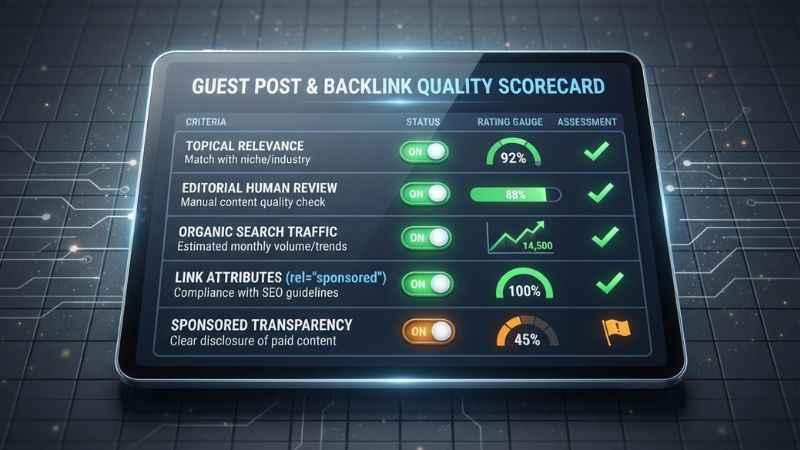
A useful review considers:
| Check | What to look for |
|---|---|
| Topical relevance | Does the publication reach readers who could genuinely benefit from your content? |
| Editorial quality | Are articles useful, readable, sourced where appropriate, and relevant to their stated subjects? |
| Audience evidence | Are traffic and audience claims supported by dated, credible data rather than an unexplained estimate? |
| Commercial terms | Are fees, deliverables, disclosures, publication timing, and removal conditions stated clearly? |
| Link treatment | Are paid or sponsored links qualified appropriately? Is the seller promising ranking credit? |
| Value beyond SEO | Would the article still make sense for readers, referral traffic, brand awareness, or public relations without a ranking benefit? |
A scorecard can help organize these questions, but it cannot guarantee that a placement is safe, valuable, or effective for SEO.
View the original guest-post quality scorecard image
What Google’s link policies mean
Google’s published spam policies identify buying or selling links primarily to manipulate search rankings as link spam. The examples include paid articles or guest posts with links that pass ranking credit. Google also explains that advertising and sponsorship links can be used when they are appropriately qualified, such as with rel="sponsored" or rel="nofollow".
This does not mean every paid editorial placement automatically violates policy. The purpose, content, and treatment of the links matter. Google’s site-reputation-abuse policy also depends on the circumstances: third-party content is a concern when it is published mainly to exploit a host site’s established ranking signals, rather than to serve readers.
These are general search-policy rules, not a finding that Extroly.com violates them. The evidence reviewed here does not establish the site’s current link practices or guarantee how Google would treat a particular placement. No backlink metric or paid post can guarantee improved rankings.
What Should You Do Before Using Extroly.com?
Your next step should depend on the interaction you are considering.
- If you want to read an article: Read critically and cross-check important claims.
- If you want to use a tool or create an account: Verify that the feature exists and identify who operates it before sharing information.
- If you want to download an app: Confirm the developer and source; do not rely on an unverified download page.
- If you want to buy a guest post: Get current terms in writing, assess the publication’s actual content and audience, and make sure the link arrangement follows applicable search policies.
- If you need to establish ownership: Look for first-party disclosures and relevant public registration or business records. Domain-registration privacy may conceal personal details; that alone does not establish wrongdoing.
The evidence available for this revision does not settle Extroly.com’s legal ownership, full current functionality, app availability, comprehensive security status, or current guest-post terms. Those questions require direct, dated records rather than assumptions based on the homepage or third-party commentary.
Frequently Asked Questions
What is Extroly.com?
The original inspection record describes a multi-topic article feed. That supports describing Extroly.com as a reported general-interest publication, while its full current functionality remains unverified.
Is Extroly.com a social network?
The available evidence does not reliably establish social-network features such as member profiles, messaging, or communities. That is a limit on what has been verified, not proof that no such feature could exist elsewhere on the domain.
Is Extroly.com an AI tool?
AI, automation, analytics, and collaboration claims have not been established as current working features by the evidence available for this revision.
Is Extroly.com a scam?
There is not enough evidence to label the domain a scam or to guarantee that it is safe. Assess the specific page, offer, download, or request for information before acting.
Does Extroly.com accept guest posts?
Third-party coverage reports a connection with guest-post or content-placement activity, but a current first-party offer and its terms were not independently verified. Confirm the exact offer before paying.
Is a backlink from Extroly.com guaranteed to improve rankings?
No. A placement does not guarantee better rankings. Paid links intended to manipulate ranking signals can violate Google’s spam policies, while appropriately qualified advertising and sponsorship links are treated differently.
Final Assessment
Extroly.com has been described in the available evidence as a multi-topic content publication, but its current features, ownership, app availability, security status, and publishing arrangements remain incompletely verified. The October 20, 2026 access attempt returned HTTP 403, which limits fresh inspection but does not establish fraud or site-wide unavailability.
For readers, verify important information elsewhere. For anyone considering an account, download, payment, or guest-post placement, confirm the operator and the specific terms first. The responsible conclusion is neither an unsupported accusation nor a blanket safety endorsement: make decisions according to the evidence available for the exact interaction.
cation Checklist in this guide to inspect any third-party website or guest-post offer before submitting payment details or downloading external files.
You May Also Like:
BetterThisWorlds.com vs. BetterThisWorld.com: Domain, Topics, and Safety Guide
StartupBooted Review 2026: Services, Pricing, and Whether It’s Worth Hiring

Joseph Quinn is the founder and editor of Punspa, a technology-focused website covering technology, website reviews, internet terms, and other things worth figuring out online. He writes and edits the site’s technology and web content, with a focus on clear, useful explanations. He also enjoys humor and wordplay, which occasionally leads him to write a pun-related article just for the fun of it.