In texts and social media, the frfr meaning is “for real, for real.” It adds strong emphasis to a message, signals total sincerity, shows deep agreement, or reacts to surprising news. However, in guitar and audio contexts, FRFR commonly stands for “Full Range, Flat Response,” a type of audio speaker system.
What Does FRFR Mean in Text?
In digital communication, frfr means “for real, for real.” It is an internet initialism derived from the common spoken phrase “for real.”
It is used in informal online messages and social-media conversations.
The literal meaning: “for real, for real”
While the shorter slang term “fr” stands for “for real,” repeating “for real” generally adds emphasis compared with fr. It often signals sincerity or emphasis, though context can make it sarcastic or ironic.
What frfr communicates in a conversation
The exact meaning of frfr depends heavily on the surrounding message and relationship between speakers.
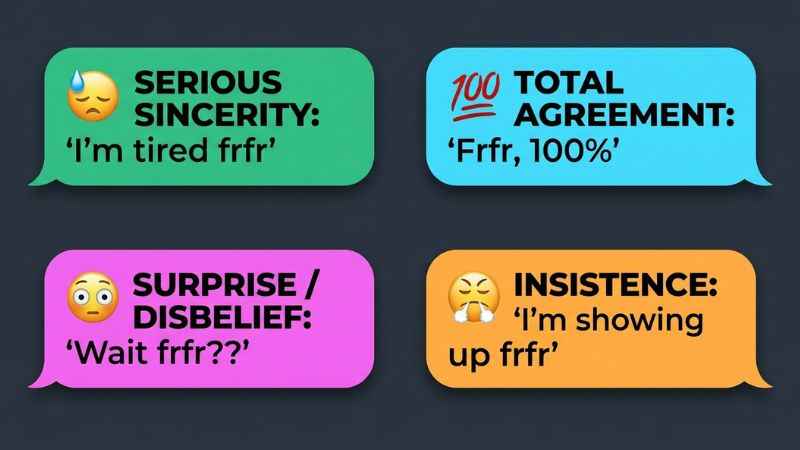
| Conversational Purpose | What the Sender Likely Means | Real-World Example |
| Serious Emphasis | “I am telling you the absolute truth.” | “That exam was hard frfr.” |
| Strong Agreement | “I completely agree with what you just said.” | “Frfr, that movie was way too long.” |
| Reassurance / Insistence | “Trust me, I am not exaggerating.” | “I will actually show up on time today frfr.” |
| Surprise / Disbelief | In some contexts, especially as a question, frfr? can ask for confirmation or convey surprise. | “He said that to you? Frfr?” |
| Playful Sarcasm | Like many emphasis markers, frfr can be used ironically when the surrounding statement is obviously exaggerated. | “Oh yeah, I am totally moving to Hawaii tomorrow frfr.” |
How to Read FRFR in Context
To understand what frfr means in chat, you must look at the surrounding conversation. Its tone depends heavily on the surrounding message and relationship between speakers.
When frfr means “I’m serious”
Placed at the end of a statement, frfr often adds emphasis or signals sincerity.
- Example: “I am so tired of this weather frfr.”
- Interpretation: The sender is not just complaining mildly; they are genuinely exhausted by the weather.
- Example: “I’m about to quit my job frfr.”
- Interpretation: It may signal that the sender wants the statement taken seriously; the surrounding conversation determines whether it is a genuine plan or a moment of frustration.
When frfr means “I agree”
As a standalone reply, frfr often signals agreement or confirmation.
- Person A: “Tacos are the best late-night food.”
- Person B: “Frfr, nothing else even comes close.”
In an agreeing reply, it can function much like “exactly” or “for real.”
When frfr signals disbelief or surprise
With question marks, frfr? can ask whether something is true; emojis and surrounding text shape the emotional tone.
- Example: “Wait, they canceled the concert? Frfr?? 😳”
- Interpretation: The sender is stunned and asking for verification.
Does frfr mean something different from a girl or guy?
No. There is no established dictionary meaning of frfr that is specific to a sender’s gender. Frfr itself is not a standard marker of romantic interest; interpret the surrounding message and relationship instead.
If you are trying to figure out what a message means, avoid overanalyzing the acronym itself. Instead, check these simple signals:
- Read the core message: Focus on the plain words around the slang.
- Look at past conversations: Do they usually text casually, or is this tone new?
- Check for direct statements: Interpret the surrounding message and relationship instead.
FR vs. FRFR vs. ISTG vs. No Cap
Online slang moves fast, and several terms share similar space with frfr. Comparing them side-by-side makes their subtle differences clear.
| Phrase | Plain-English Meaning | Description / Tone | Best Use Case | Example |
| FR | “For real” | Often used for mild emphasis | Casual agreement or quick validation. | “That restaurant is great, fr.” |
| FRFR | “For real, for real” | Often used to stress sincerity | Strong emphasis, serious claims, deep agreement. | “I am not going back there frfr.” |
| ISTG | “I swear to God” | Used to intensify a statement, often in contexts of frustration, emphasis, or sincerity | Expressing frustration, emphasis, or sincerity. | “ISTG if this train is late again I’m walking.” |
| No Cap | “No lie” | Stresses honesty or truthfulness | Stating a factual truth or calling out exaggeration. | “That was the best pizza in town, no cap.” |
| Deadass | “Completely serious” | Emphasizes seriousness or honesty | Emphasizing complete honesty or asking if someone is serious. | “Are you deadass right now?” |
When combined, the abbreviations can intensify a message; interpretation remains context-dependent. For instance, “istg frfr” combines “I swear to God” and “for real, for real” to add extra emphasis to a message.
How to Use FRFR and How to Reply
It can appear in different positions in informal messages, but natural placement varies by sentence and speaker.
Natural ways to use frfr
Here are five practical examples across different casual settings:
- To show strong agreement in a group chat: “Frfr, that was the best episode of the season.”
- To emphasize a personal statement in a DM: “I need a vacation frfr.”
- To react to news online: “That drop was clean frfr 🔥”
- To correct someone’s doubt: “No, I actually finished the whole assignment frfr.”
- To express disbelief: “You met them in person? Frfr?”
Easy responses to frfr
When someone sends you a message containing frfr, your reply should match their level of seriousness or agreement.
| Context | Useful Reply | Why It Works |
| They expressed agreement | “Exactly.” or “100%” | Keeps the conversation moving cleanly. |
| They made a serious point | “I know, right?” | Validates their feelings without overcomplicating things. |
| They shared shocking news | “Wait, seriously?” or “No way.” | Prompts them to share more details. |
| They shared a shared struggle | “Same here.” or “Real.” | Shows quick empathy. |
| They asserted a truth | “I believe you!” | Confirms you trust their word. |
When not to use it
In formal writing, standard wording is generally clearer and more appropriate than casual slang.
- Professional email: “I am frfr working on that report today.” (Avoid)
- Better alternative: “I am actively working on that report today and will have it to you shortly.”
Formal contexts generally favor clear, standard language.
What Does FRFR Mean in Music and Guitar Gear?
If you step away from social media and visit an audio store, music forum, or guitar gear site, FRFR carries a technical meaning.
Full Range, Flat Response explained
In audio, FRFR refers to a full-range, flat-response speaker system, which can include powered guitar cabinets, PA speakers, or studio monitors. FRFR describes a speaker system designed to reproduce a broad frequency range as neutrally as possible; actual range and flatness vary by model.
- Full Range: In this context, “full range” means broader-band reproduction than a conventional guitar cabinet. Actual specifications vary; many guitar-oriented FRFR speakers extend roughly from 50–60 Hz to 20 kHz.
- Flat Response: Flat response means the speaker is designed to minimize tonal coloration; real-world frequency response is not perfectly flat and varies by model, level, placement, DSP settings, and room.
The goal is relatively neutral reproduction of the incoming signal, subject to the speaker’s design, settings, output limits, and listening environment.
FRFR speaker vs. traditional guitar cabinet
Conventional guitar speakers are voiced with non-flat, limited frequency responses that are part of the instrument’s sound. Traditional guitar cabinets typically have a narrower and more characterful response than FRFR systems; the exact bass, midrange, and treble behavior depends on the speaker and cabinet.
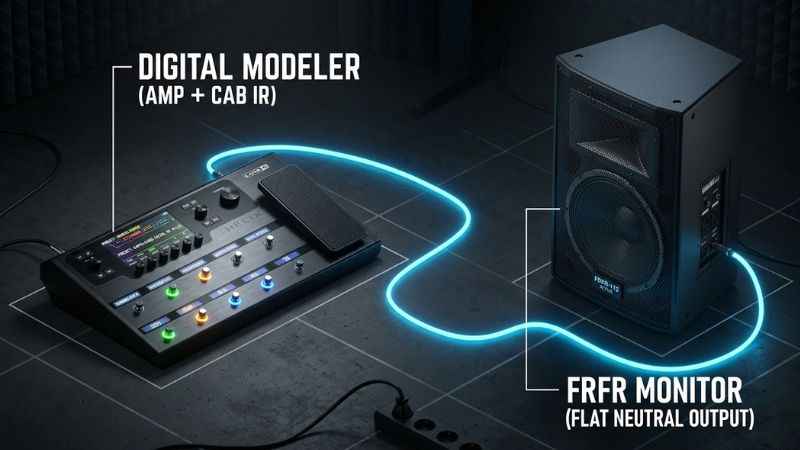
Digital amp modelers such as Line 6 Helix, Kemper Profiler, and Fractal Audio Axe-Fx can emulate, model, profile, or load representations of guitar amps, cabinets, microphones, and impulse responses. Running a cab-sim/IR signal through a conventional guitar cabinet can apply both the virtual cabinet response and the physical cabinet’s response. Many systems therefore recommend disabling cabinet simulation when feeding a traditional guitar cabinet. An FRFR speaker is designed to reproduce modeled amp-and-cab output more neutrally than a traditional guitar cabinet, though speaker voicing, placement, EQ, and room acoustics still affect the result.
| Feature | FRFR Speaker System | Traditional Guitar Cabinet |
| Primary Input Source | Digital amp modelers, multi-effects pedals, PA mixers. | Traditional tube or solid-state guitar amp heads. |
| Tonal Coloration | Neutral / Flat (designed to minimize coloration). | High (actively shapes and colors the tone). |
| Frequency Range | Broad-band/full-range design; actual published frequency response varies by model. | More limited and non-flat than FRFR; actual response varies substantially by speaker and cabinet design. |
| Cabinet Simulation Use | For conventional electric-guitar amp-model tones, players commonly keep cabinet simulation or IRs enabled when using FRFR. It is not universally required for every signal or desired sound. | When feeding a conventional guitar cabinet directly, users commonly disable cabinet simulation to avoid applying a virtual cabinet response on top of the physical cabinet. |
Common FRFR Mistakes and Misunderstandings
Clear communication means avoiding a few common traps when reading or writing this term:
- Assuming frfr always means agreement: It can also mean surprise, insistence, or playful irony depending on the context.
- Overanalyzing sender gender: People often search for “frfr meaning from a girl,” but acronyms do not carry gender-specific rules. Read the conversation as a whole.
- Using slang in work messages: Keep initialisms in personal chats. Stick to clear, standard phrasing in professional environments.
- Confusing text slang with music gear: In a chat or social-media context, frfr usually refers to “for real, for real”; in guitar/audio contexts, FRFR commonly means “Full Range, Flat Response.” Capitalization alone is not decisive.
- Assuming an FRFR speaker guarantees perfect sound: An FRFR speaker aims for a flat response, but actual response varies by speaker model and setup.
FRFR Meaning FAQs
Is frfr a Gen Z slang term?
Frfr is widely used in informal online communication.
Is frfr rude?
Frfr is not inherently profane, but it can sound overly casual or dismissive depending on the context.
Can frfr be sarcastic?
It can be used ironically in an obviously exaggerated context, but context is necessary to tell.
What does “istg frfr” mean?
When combined, the abbreviations can intensify a message; interpretation remains context-dependent.
Is frfr the same as “for real”?
It comes from the same phrase, but repeating “for real” generally adds emphasis compared with fr.
What does frr mean in a text?
Frr has no single universally established meaning; it may be a typo or an expressive spelling of fr, depending on context.
Should I use frfr in a work message?
No. Stick to Standard English in workplace emails, client interactions, or professional chats like Slack and Teams.
Does FRFR always mean “for real, for real”?
In most casual text and social-media conversations, frfr means “for real, for real”; context can still change the intended meaning.
To decipher frfr, look at where you found it: in a casual text message, frfr adds strong emphasis to “for real, for real,” while in audio or guitar contexts, FRFR commonly means “Full Range, Flat Response.”
You May Also Like:
Stugots Meaning: Origin, Usage, and the Sopranos Connection
R&R Meaning: What It Stands For in Everyday Life, Work, Auto Repair, and More

Joseph Quinn is the founder and editor of Punspa, a technology-focused website covering technology, website reviews, internet terms, and other things worth figuring out online. He writes and edits the site’s technology and web content, with a focus on clear, useful explanations. He also enjoys humor and wordplay, which occasionally leads him to write a pun-related article just for the fun of it.