The term new software name mozillod5.2f5 refers to an unverified software identifier. I found no public Mozilla product or Firefox release documentation identifying “mozillod5.2f5” as an official product or release. Without the actual file or context, its identity is unknown. Possible explanations include a filename, build artifact, unofficial fork, third-party installer, or spoofed file.
The official Mozilla public product and Firefox documentation reviewed for this article on September 22, 2026, did not identify the term. Always verify the publisher before opening unknown files on your computer.
What Is Confirmed About Mozillod5.2f5?
The term appears in online search results. Whether it appears in a particular download or system log depends on the user’s specific file or log. I found no official Mozilla documentation identifying it as a Firefox release, Mozilla product, or official update. Treat any file using this name with caution until you verify its source.
| Confirmed Facts | Unconfirmed Claims | Completely Unknown Features |
| • The search term exists online. | • Official developer or publisher | • Harmless or malicious intent |
| • Not listed on Mozilla products | • Product features and tools | • True source of specific files |
| • Not an official Firefox channel | • Pricing or free trial offers | • Intended system function |
Several indexed third-party pages make conflicting claims about the name. Some third-party pages describe it as browser-related or as a broader software tool, but I found no official source confirming those descriptions. These claims are unsupported. Some third-party pages publish speculative descriptions without showing primary-source documentation or reproducible testing. Some pages do not provide evidence of testing or links to authoritative documentation.
Is Mozillod5.2f5 an Official Mozilla or Firefox Release?
No official Mozilla product or Firefox release using this identifier was found in the public Mozilla product, Firefox documentation, and release sources reviewed. Mozilla publicly documents Firefox release channels and publishes release information, although internal or third-party build identifiers may not follow the public product naming pattern.
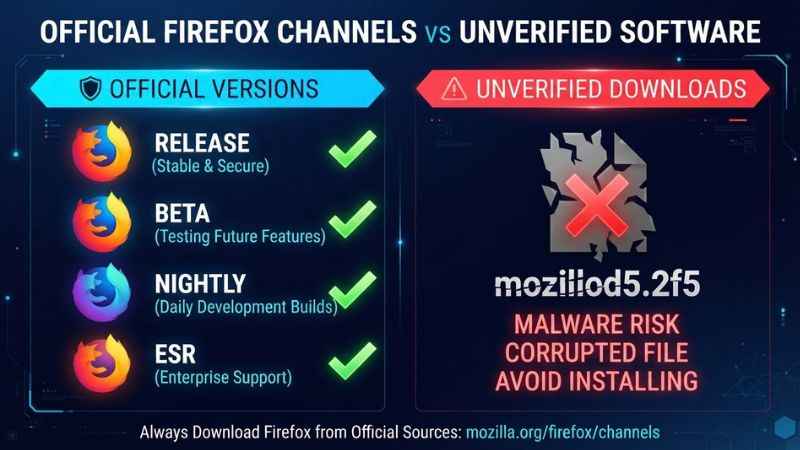
| Official Firefox Products & Channels | What It Represents | Official Public Listing Available? |
| Firefox Release | General-release channel for everyday users | Yes |
| Firefox Beta | Pre-release channel for testing | Yes |
| Firefox Nightly | Development channel updated daily | Yes |
| Firefox Developer Edition | Separate desktop product tailored for web developers | Yes |
| Firefox ESR | Extended-support product/release track for enterprise | Yes |
| Mozillod5.2f5 | Unverified software identifier | No |
A file name containing the word “mozilla” does not guarantee Mozilla created it. Anyone can name a computer file, a folder, or a software installer after a famous brand. Distinguish between official brand software and unofficial files that copy a brand name.
To evaluate software authenticity, use several checks together: use an official Mozilla-controlled source such as Firefox.com or the relevant Mozilla.org page, check for matching release documentation, check that the executable has a valid code-signing certificate whose publisher identity matches the expected Mozilla entity, and—where available—verify a matching checksum or package signature.
What Could the Mozillod5.2f5 Identifier Represent?
When you encounter an unfamiliar software name, possible explanations include a filename, build artifact, unofficial fork, third-party installer, or spoofed file.
| Possible Interpretation | What It Means | Evidence Needed to Prove It |
| Custom Firefox Fork | Independent software based on open-source Firefox code | Public code repository and clear developer details |
| Developer or Test Artifact | Internal file created during continuous integration | Log file context or continuous integration build pipeline tags |
| Third-Party Installer | Bundled software from an unofficial download mirror | Installer manifest and file path properties |
| Spoofed Filename | Misleading name designed to hide untrusted software | Invalid digital signature or security scanner detection |
A Custom or Unofficial Firefox Build
Firefox source code and build documentation are publicly available, so third parties can create modified or forked builds. A third-party fork is not automatically dangerous and should not be assumed to be officially supported by Mozilla. Verify the fork’s own publisher, source, update process, and security practices.
A Developer or Test Artifact
A complex name could be a build or test artifact, but that interpretation requires evidence from the relevant log, repository, or build system. If you see this name in a diagnostic log, it could be a build artifact, package label, path, extension, or other internal value; the surrounding log context is needed to identify it.
A Third-Party Installer or Bundled Component
Some third-party download sites may distribute repackaged installers or bundles; verify the publisher and source before installing. Repackaged installers may include additional components, so inspect the installer source, publisher, and installation options.
A Spoofed or Suspicious Filename
Attackers can use brand-like filenames to make software appear trustworthy, but the name alone does not establish that this file was renamed by criminals.
How to Verify a Mozillod5.2f5 File Safely
If you downloaded a file using the new software name mozillod5.2f5, do not run it immediately. Follow these verification steps first.
Step 1: Complete the Pre-Opening Checklist
- Do not run or open the file. Keep it idle in your downloads folder.
- Write down the full name and file extension (such as .exe, .dmg, or .zip).
- Record where you got it. Save the website address or application source.
- Keep your operating system and security tools enabled and up to date before handling unknown files.
Step 2: Inspect the File Publisher and Digital Signature
Check the digital signature of the file using your operating system’s built-in tools.
On Windows
- Right-click the file and select Properties.
- Click the Digital Signatures tab.
- Select the signature name and click Details.
- For a Windows Firefox installer, verify that the digital signature is valid and that the signer matches the publisher identity shown in Mozilla’s current support or download documentation.
+—————————————————————-+
| Mozillod5.2f5 Properties (Fictional Example) [X]|
+—————————————————————-+
| General | Security | Details | Digital Signatures | |
+—————————————————————-+
| Signature list: |
| +————————————————————+ |
| | Signer | Digest algorithm | Timestamp | |
| | Unknown Publisher | sha256 | None | |
| +————————————————————+ |
| |
| [ View Details ] |
| |
| [ OK ] [ Cancel ] |
+—————————————————————-+
On macOS
- Open the Terminal app.
- Type codesign -dv –verbose=4 followed by a space.
- Drag the file into the Terminal window and press Enter.
- On macOS, inspect the signing identity with codesign, and use macOS’s Gatekeeper or spctl assessment to check whether the application is accepted and notarized. Compare the developer identity with the official download source. Do not rely on one hard-coded certificate name for every release.
On Linux
- Open your terminal.
- Check if the file came from your official distribution package manager.
- Use the distribution’s supported repository and package-signature verification process; the exact method varies by distribution and package format.
Step 3: Check the SHA-256 File Hash
A SHA-256 hash is a cryptographic digest used to compare whether two files are likely identical.
- Open your command prompt or terminal.
- On Windows, run: certutil -hashfile filename.exe SHA256
- On macOS or Linux, run: shasum -a 256 filename
- You can search a SHA-256 hash on VirusTotal, but a hash result may be unavailable. A hash lookup does not submit the file itself. Uploading a file can expose it to a public analysis service unless a private-scanning option is used. Avoid uploading confidential files to public scanning services; use an appropriate private-scanning or organizational process when needed.
- VirusTotal aggregates results from multiple security vendors and analysis services. Results can be incomplete, delayed, or false-positive/false-negative, and a clean result does not prove legitimacy.
Should You Install or Download Mozillod5.2f5?
Do not execute or install an unknown file using this label until its source, type, publisher, signature, and context have been verified. No official source, verified publisher, or product page for this identifier was found in the public sources reviewed.
Safety Warning: Avoid downloading software from third-party file-sharing sites, pop-up ads, or suspicious download mirrors. Download Firefox from Firefox.com or follow the current Firefox download link provided by Mozilla Support, or from an officially supported app store.
What NOT to Believe About This Software
- No Documented Pricing: No reliable pricing information for a verified product named mozillod5.2f5 was found. Do not infer anything about pricing from the identifier.
- No Confirmed Features: No authoritative source reviewed confirms AI features, speed claims, or integrated dashboards for a product using this identifier.
- No Version Meaning: The suffix “f5” has no established meaning for this identifier in the official Mozilla sources reviewed; do not assume that it means final, stable, or release five.
- No Mobile Apps: No verified iOS or Android app using the name mozillod5.2f5 was found. Mozilla separately distributes official Firefox mobile apps.
What to Do If You Already Ran the File
If you actually executed an unknown file with this name, consider the following incident-response steps, especially if you observe suspicious behavior.
Step 1: Disconnect and Scan
- Isolate network connections. If compromise is suspected, isolate the device from networks when appropriate; on an organizational device, follow your incident-response or IT procedure before taking action.
- Run a security scan. Run the platform’s available malware checks and a reputable, up-to-date security scan. On macOS, use the available built-in protections and a trusted security tool or professional assessment when deeper scanning is needed.
- Inspect running processes. Record and investigate suspicious processes before terminating them; use the operating system’s trusted tools or consult IT/security personnel.
Step 2: Check System Settings and Credentials
- Inspect startup apps. Look at your system settings to see if unknown programs start automatically when you boot up. These checks can reveal persistence or unwanted changes, but an unfamiliar startup item or extension is not automatically malicious; verify its publisher and installation source before removing it.
- Review browser extensions. Open your web browsers and delete extensions you did not install yourself.
- Update credentials if necessary. If the file may have accessed credentials, change important passwords from a trusted device and enable multifactor authentication where available.
Step 3: Handle Log Entries
If you found mozillod5.2f5 inside a system log rather than an active file:
- Investigate context. A log entry is a record and does not by itself prove that an active program exists, but investigate the process, path, and application that generated it.
- Trace the source. Check which software created the log file, such as a web browser, a local server, or a developer framework.
- Check for path locations. A log string could represent a build label, extension, framework, path, or other value; determine its meaning from the surrounding log context and generating application.
Common Mistakes When Researching Unfamiliar Software
When checking unknown software names online, avoid these frequent traps:
- Trusting repeated blog articles: Seeing an unverified claim on several sites does not make it true.
- Assuming brand names mean safety: Anyone can put “Mozilla” or “Firefox” in a file title. Always verify the publisher certificate.
- Relying only on a clean scan: Scan the file with up-to-date security tools and separately verify its source, publisher, signature, and checksum; do not treat a clean scan as proof of legitimacy.
- Deleting system files blindly: Deleting files inside system directories without checking what created them can break software on your computer.
Frequently Asked Questions
Is mozillod5.2f5 an official Mozilla product?
No. The identifier was not found in the public Mozilla product, Firefox channel, and release sources reviewed. Treat it as an unverified software name until official sources state otherwise.
Is mozillod5.2f5 Firefox?
There is no verified proof that this name represents a standard Firefox web browser. Those are possible interpretations, but the available evidence does not identify which one applies.
Is mozillod5.2f5 malware?
The name alone does not prove a file is malware. However, because it uses brand-like naming without official verification, you should scan the file with up-to-date security tools and separately verify its source, publisher, signature, and checksum; do not treat a clean scan as proof of legitimacy.
Should I download mozillod5.2f5?
Do not download or run an unknown executable or installer using this label unless its provenance and authenticity have been verified. Download software only from official publisher websites to protect your system.
How do I check whether the file is genuine?
Right-click the file and inspect its digital signature properties. For a genuine Firefox installer, the publisher/signing identity should match the official Mozilla documentation for that platform and distribution method.
What if I found the name in a system log?
Check which application generated the log file. A log string could represent a build label, extension, framework, path, or other value; determine its meaning from the surrounding log context and generating application.
Can I remove mozillod5.2f5?
If it is only an unexecuted, unwanted download, deletion is generally appropriate after recording its provenance; if it was executed or installed, investigate before removal. For a verified legitimate application, use the standard uninstall process; for an unknown or suspicious program, use trusted security-removal guidance and check persistence mechanisms.
Next Steps: Protect Your Device
If you are looking for a web browser or want to update your current software, do not rely on third-party file names.
Use the current official Firefox download page at Firefox.com or follow the current Firefox download link provided by Mozilla Support to get genuine, safe Firefox releases directly from the developer. If you ran an unknown file, isolate or assess the device according to your security procedure, preserve relevant evidence where necessary, and run an appropriate up-to-date security scan.
You May Also Like:
Droven.io AI Tools 2026: Complete Guide
Fappelo Explained: What It Is, Which Website Is Official, and How It Differs From Fapello

Joseph Quinn is the founder and editor of Punspa, a technology-focused website covering technology, website reviews, internet terms, and other things worth figuring out online. He writes and edits the site’s technology and web content, with a focus on clear, useful explanations. He also enjoys humor and wordplay, which occasionally leads him to write a pun-related article just for the fun of it.