A simile compares two different things using the words “like” or “as” to create a vivid image in the reader’s mind. For example, saying “She is as brave as a lion” or “He ran like the wind” paints a quick picture that plain descriptions cannot match. Writers use similes examples to make creative stories, school essays, and daily conversations more engaging and fun to read.
What Is a Simile? (Simple Definition + Quick Examples)
Quick Answer: A simile is a figure of speech that compares two completely different things by using the words “like” or “as.” It highlights a shared quality to make writing more visual.
Here are a few quick examples of similes in action:
- As busy as a bee (Describes someone working non-stop)
- As cool as a cucumber (Describes someone staying calm under pressure)
- Shine like a diamond (Describes something bright or outstanding)
- Fight like cats and dogs (Describes two people arguing fiercely)
- As clear as crystal (Describes something easy to see or understand)
- Eats like a horse (Describes someone with a huge appetite)
Using similes helps readers see, hear, or feel what you are describing without needing long explanations.
How Similes Work: Structure, Patterns, and Types
Similes follow simple rules that make them easy to build. Once you spot the core patterns, you can use them anywhere in your writing.
The Basic Pattern: “A is like B” and “A is as [adjective] as B”
Most similes rely on two basic formulas. The first connects two nouns using “like,” while the second uses “as” before and after a describing word.
- Pattern 1 (“like”): The new car sped like a rocket down the track.
- Pattern 1 (“like”): Her laugh sounded like tiny ringing bells.
- Pattern 2 (“as…as”): The ice on the pond was as smooth as glass.
- Pattern 2 (“as…as”): His hands were as cold as ice after playing in the snow.
Common Simile Patterns in Everyday English
Many similes are so common that they have become fixed expressions in daily conversation. You might hear people use these everyday patterns at home or in class:
- Like a fish out of water: Feeling awkward because you are in an unfamiliar place.
- As blind as a bat: Having very poor eyesight or failing to notice something obvious.
- Like watching paint dry: Extremely boring or slow to happen.
- As light as a feather: Weighing very little and easy to lift.
100+ Similes Examples Organized by Use-Case
Everyday Similes (Conversation & ESL)
These short sentence examples use simple ideas like speed, mood, and health. They are great for school assignments or practicing everyday English.
- The sleeping puppy was as quiet as a mouse.
- After the long hike, my legs felt as heavy as lead.
- She answered every question as quick as lightning.
- The fresh bread was as soft as a pillow.
- My grandfather is as wise as an owl.
- The dirty floor was as slippery as an eel.
- He stood as still as a statue during the trick.
- Her voice sounded as sweet as honey.
- The hot sun made the yard feel like an oven.
- They worked together like a well-oiled machine.
- My brother sleeps like a log every night.
- The news spread like wildfire through the hallway.
- Her cheeks turned as red as a tomato.
- The old trunk was as heavy as a rock.
- He can swim like a dolphin in deep water.
- The test was as easy as pie.
- She moved around the house like a ghost.
- His hands were as tough as leather.
- The dark room was as black as night.
- That idea is as old as the hills.
- The kitten was as small as a teacup.
- The child bounced around like a rubber ball.
- The cake tasted as dry as dust.
- He fits into the group like a missing puzzle piece.
- Her eyes sparkled like stars in the night sky.
Similes for Creative Writing (Emotions, Setting, Movement)
Use these creative options to paint clear pictures in stories without relying on boring phrases.
| Category | Overused Cliché | Fresh Creative Option |
| Emotions | She was as angry as a hornet. | Fear gripped his chest like a tight iron band. |
| Emotions | Joy made her jump like a bean. | Happiness burst through her like a splash of cold water on a hot day. |
| Emotions | He felt as sad as a rainy day. | Grief sat on his shoulders like a heavy wet coat. |
| Setting | The fog was as thick as soup. | Fog wrapped around the houses like a thick wool blanket. |
| Setting | The wind blew like a gale. | The winter wind cut through the trees like a sharp razor. |
| Setting | The desert was as hot as fire. | The afternoon heat settled over the valley like a heavy wool blanket. |
| Movement | He ran as fast as a cheetah. | The dancer spun across the stage like a dry leaf in a gust of wind. |
| Movement | She moved like a snail. | The old truck crept up the mountain road like a tired turtle. |
More Examples for Storytelling:
- Anger flared inside him like a lit match dropped in dry grass.
- The quiet house felt as empty as an abandoned bird nest.
- Rain pounded the glass like tiny drumsticks.
- He dropped to the floor like a sack of flour.
- Shadows stretched across the garden like long dark fingers.
- Her thoughts raced like dry leaves tossed in a storm.
- The lake looked as flat as a mirror in the morning light.
- The engine roared like a trapped mountain lion.
- Doubts crept into his mind like cold drafty air under a door.
- She disappeared into the crowd like a drop of ink in water.
Similes in Literature and Poetry
Famous authors use similes to give their writing deep meaning and strong imagery.
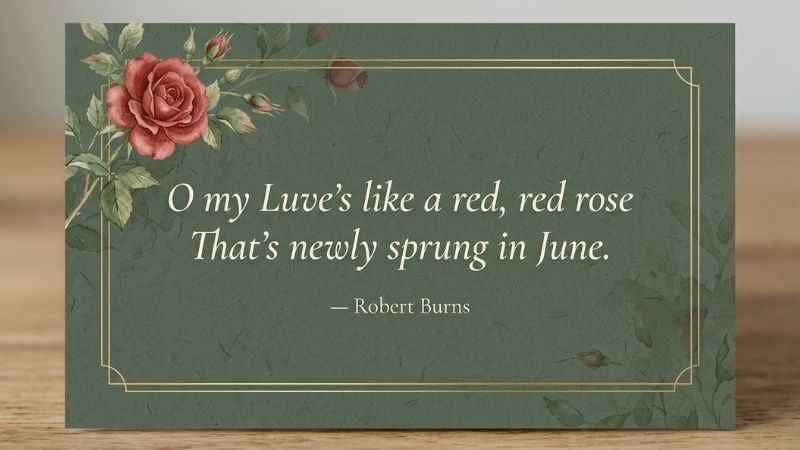
- Robert Burns (“A Red, Red Rose”): “O my Luve’s like a red, red rose / That’s newly sprung in June.”Why it works: Burns compares love to a blooming flower to show how fresh and lovely it feels.
- F. Scott Fitzgerald (The Great Gatsby): “In his blue gardens men and girls came and went like moths among the whisperings and the champagne and the stars.”Why it works: The guests are compared to moths to suggest they are drawn to light and excitement for only a brief moment.
- Ernest Hemingway (A Farewell to Arms): The world breaks everyone, and afterward, many are “strong at the broken places.” (This line is a declarative prose statement rather than a simile, illustrating how Hemingway’s sparse style achieves impact without relying on decorative comparisons).
- Langston Hughes (“Harlem”): “What happens to a dream deferred? / Does it dry up / like a raisin in the sun?”Why it works: This line compares a delayed dream to a dried fruit to show how shrinking back from goals drains life away.
- Sylvia Plath (“Morning Song”): “Love set you going like a fat gold watch.”Why it works: Comparing a newborn baby’s start in life to a valuable watch highlights how precious and precisely timed new life feels.
Simile vs Metaphor vs Personification vs Analogy
Understanding how figurative devices differ keeps your writing clear and prevents confusion.
Simile vs Metaphor: The One-Big-Difference Rule
The Rule: A simile uses the word “like” or “as” to connect two items. A metaphor skips those words and states that one thing is the other.
- Simile: Time is like a thief that steals our hours.
- Metaphor: Time is a thief that steals our hours.
Personification and Analogy
Personification gives human traits or actions to non-human things or objects. For example: “The wind whispered through the trees.”
An analogy is a longer comparison that explains a tricky idea by linking it to something familiar. An analogy often builds on similes or metaphors to prove a point, such as explaining how an atom works by comparing its structure to our solar system.
| Device | Definition | Simple Example |
| Simile | Compares two things using “like” or “as” | Her smile is as bright as the sun. |
| Metaphor | Compares two things directly by stating one is the other | Her smile is a ray of sunshine. |
| Personification | Gives human actions or feelings to non-human objects | The sun smiled down on the park. |
| Analogy | Explains a complex idea using an extended comparison | Finding a good book is like searching for a needle in a haystack. |
How to Write Your Own Similes (Step-by-Step)
Creating original comparisons makes your writing stand out. Follow these three easy steps to build your own.
A 3-Step Method to Craft Original Similes
Plaintext
Step 1: Choose the trait (e.g., Fast)
   │
   ▼
Step 2: Pick a matching object (e.g., A dart hitting a target)
   │
   ▼
Step 3: Connect with "like" or "as" ➔ "He closed the bag as fast as a dart hitting a target."
- Identify the trait: Pick the exact feeling or action you want to describe (e.g., Speed).
- Choose a unique image: Brainstorm real objects or scenes that match that quality (e.g., A dart hitting a target).
- Connect and polish: Join the ideas using “like” or “as,” then cut out unnecessary words.
Cliché to Fresh: Rewriting Overused Similes
Overused phrases can make your writing feel boring. Swap old patterns for fresh ideas:
- Cliché: He was as busy as a bee.Fresh Rewrite: He moved around the kitchen like a juggler with six spinning plates.
- Cliché: She slept like a baby.Fresh Rewrite: She slept like a phone placed on its charger for the night.
- Cliché: It was as cold as ice.Fresh Rewrite: The winter wind bit his nose like a hungry puppy.
Common Mistakes When Using Similes (And How to Fix Them)
Avoid these common slip-ups to keep your creative writing strong and smooth.
- Illogical Comparisons: Make sure the two items actually share the trait you are describing.
- Wrong: He ran as fast as a quiet room. (Quietness does not relate to speed.)
- Fix: He ran as fast as a startled deer.
- Mixed Similes: Combining two different images in one sentence confuses the reader.
- Wrong: Our team swam like sharks and flew like eagles across the court.
- Fix: Our team moved across the court like a well-drilled squad.
- Overcrowded Sentences: Using too many similes in one paragraph makes your text hard to follow.
- Fix: Use one strong simile instead of three weak ones back-to-back.
Similes for Kids and Students (Grade-Level Friendly)
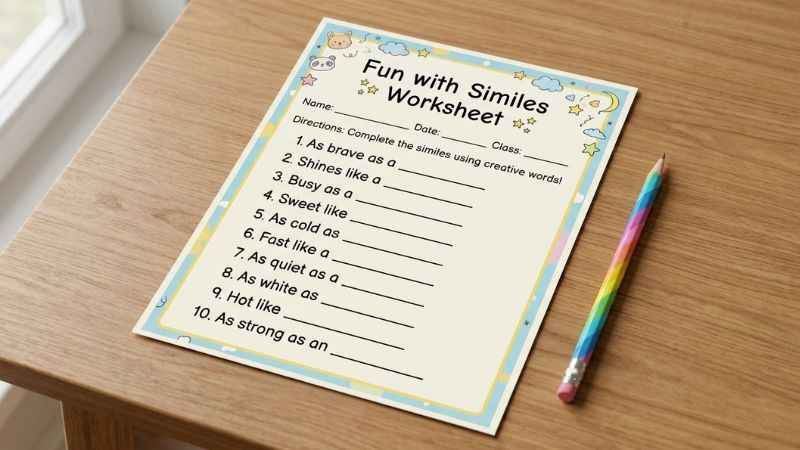
Teachers and students in Grade 3 through Grade 7 can use these easy examples in classroom assignments and writing tests:
- The grass felt as soft as a carpet under our bare feet.
- The flashlight shone like a bright beam in the dark cave.
- My dog hides under the bed like a scared turtle during storms.
- Her new shoes were as shiny as new coins.
- The classroom was as quiet as a library during the test.
- The warm soup tasted like a hug on a chilly day.
- He jumped up and down like a popcorn kernel in a hot pan.
- The ice cream melted like snow in the sun.
Study Tip: When writing essays, limit yourself to one or two well-chosen similes per page. This keeps your writing clear without overwhelming the grader.
When to Avoid Similes (And What to Use Instead)
Similes are great for creative tasks, but they do not belong in every type of writing. Avoid similes in these situations:
- Technical Reports & Science Papers: Use exact measurements instead of figurative descriptions. Write “The temperature dropped to 32 degrees,” not “It got as cold as a freezer.”
- Fast-Paced Action Scenes: Long comparisons slow down the reading speed. Use strong, action-focused verbs instead.
- Formal Business Emails: Plain language keeps your messages clear and professional.
FAQ: Similes Examples
What is a simile?
A simile is a figure of speech that compares two different things using the words “like” or “as.” An example is “as sharp as a tack.”
What are 10 examples of similes?
Ten common similes include: as brave as a lion, works like a charm, as busy as a bee, swims like a fish, as light as a feather, cool as a cucumber, eats like a horse, as quiet as a mouse, shines like a star, and as hard as a rock.
How is a simile different from a metaphor?
A simile uses “like” or “as” to make a comparison (e.g., “life is like a highway”). A metaphor states the comparison directly without using those words (e.g., “life is a highway”).
What are some similes using “like” and “as”?
Examples using “like” include “sleeps like a log” and “soars like an eagle.” Examples using “as” include “as cold as ice” and “as white as snow.”
What are good similes for kids and students?
Simple similes for students include “as sweet as honey,” “moves like a snail,” and “as clear as day.”
How do you write an original simile?
Pick a specific quality you want to describe, brainstorm an object that naturally fits that trait, and join them together using “like” or “as.”
Quick Reference: Simile Patterns You Can Reuse
Use this fill-in-the-blank cheat sheet to craft your own sentences quickly:
- As [adjective] as a [noun] ➔ As strong as an ox
- Moves like a [fast/slow animal] ➔ Moves like a cheetah
- Works like a [tool/machine] ➔ Works like a charm
- Fits like a [clothing item/object] ➔ Fits like a glove
- Bright like a [light source] ➔ Bright like a flashlight
- Sounds like [familiar noise] ➔ Sounds like thunder
Next Action Step
Pick three overused descriptions in your current writing draft and use the 3-step method above to replace them with fresh, original similes.
You May Also Like:
ETA Meaning: What Does ETA Stand For and How Is It Used?
PMG Meaning: The Complete Context Guide (2026)

Joseph Quinn is the founder and editor of Punspa, a technology-focused website covering technology, website reviews, internet terms, and other things worth figuring out online. He writes and edits the site’s technology and web content, with a focus on clear, useful explanations. He also enjoys humor and wordplay, which occasionally leads him to write a pun-related article just for the fun of it.