SPH meaning on an eye prescription stands for Sphere. It measures the main lens power you need to correct distance or near vision, measured in units called diopters. A minus sign (−) before the number means you are nearsighted, while a plus sign (+) means you are farsighted. SPH shows lens strength, not your overall eye health.
What Does SPH Mean on Glasses?
SPH stands for Sphere. It is the primary lens power needed to focus light correctly onto the back of your eye.
The term “sphere” means that this corrective power is equal across the entire lens. It curves the same way in every direction, like a section of a ball.
Your doctor measures SPH power in diopters (D). Diopters tell you how strongly a lens must bend light. Numbers closer to zero mean you need mild vision correction. Numbers farther from zero mean you need stronger lenses.
SPH in one sentence: The SPH field on an eye prescription shows the spherical lens power, measured in diopters, needed to correct overall nearsightedness or farsightedness.
Why It Is Called “Sphere”
Eye doctors use the word sphere to separate this value from astigmatism correction. A spherical lens has the same curvature across its whole surface.
In contrast, astigmatism requires a shaped lens that bends light differently along distinct angles. That type of correction is listed under separate prescription columns called CYL and AXIS.
What Diopters Measure
Diopters measure how much optical correction your lens provides. The optical system uses steps of 0.25 diopters, such as 0.25, 0.50, 0.75, or 1.00.
- A −1.00 D lens provides a mild amount of power for distance vision.
- A +2.00 D lens provides a moderate amount of power for near vision.
Higher diopter values require thicker, stronger lenses. However, a high diopter number only describes lens strength. It does not measure whether your eyes are healthy or diseased.
How to Read a Plus or Minus SPH Value
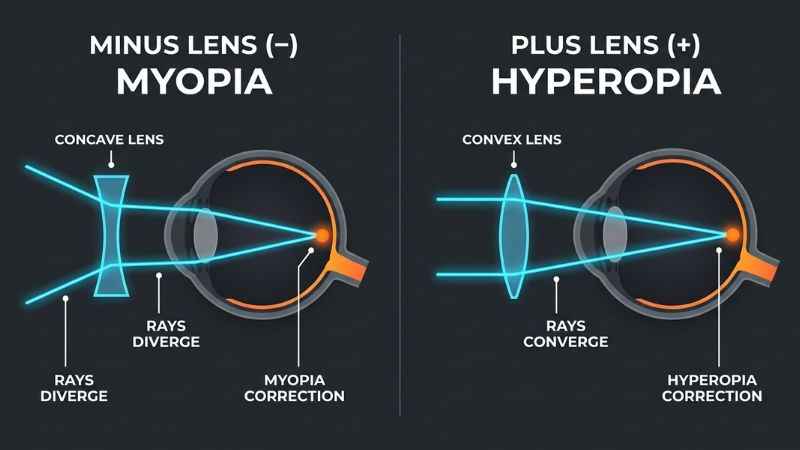
The symbol before your SPH number tells you how your eye focuses light. A minus sign means light focuses in front of your retina. A plus sign means light focuses behind it.
| SPH Display | Usually Indicates | Without Correction | Example Interpretation | Important Limitation |
| −1.25 | Myopia / Nearsightedness | Far objects look blurry | Mild minus power for distance vision | Does not show astigmatism or eye health |
| +0.75 | Hyperopia / Farsightedness | Near focus takes extra effort | Low plus power for reading or close work | Needs vary by age and focus ability |
| 0.00 or Plano | No spherical power | Depends on other values | Zero spherical correction needed | Does not mean your overall vision is perfect |
Negative SPH: Myopia Explained
A minus sign (−) in front of your SPH number means you have myopia, also called nearsightedness or short-sightedness. Close objects appear clear, but distant objects look blurry.
For example, an SPH of −2.00 means you need two diopters of minus power to see clear details at a distance. When buying glasses online or filling out forms, never leave off the minus sign. Leaving it off completely changes the prescription.
Example: SPH -2.50 = Nearsighted (Distance Blur)
Positive SPH: Hyperopia Explained
A plus sign (+) in front of your SPH number means you have hyperopia, also called farsightedness or long-sightedness. Distant objects are usually easier to focus on, while close objects require extra effort or look blurry.
Younger adults with mild plus power can sometimes force their eyes to focus up close without glasses. As you age, that focusing work becomes harder, causing eye strain or fatigue.
Example: SPH +1.50 = Farsighted (Near Blur / Eye Strain)
Does a Larger SPH Number Mean Worse Eyesight?
A larger number simply means you need a stronger piece of glass or plastic to focus light. It measures lens strength, not visual health.
- Distance from zero: An SPH of −6.00 is stronger than an SPH of −1.50. Likewise, +4.00 is stronger than +1.00.
- Visual acuity: SPH does not measure your visual acuity score, such as 20/20 or 20/40.
- Eye disease: Two people can have an SPH of −3.00, yet one may have completely healthy eyes while the other deals with dry eyes or glaucoma.
Common Misconception: A high SPH value does not mean you are going blind or have damaged eyes. It only means your eyeball is shaped slightly longer or shorter than average.
Read SPH in a Full Eye Prescription
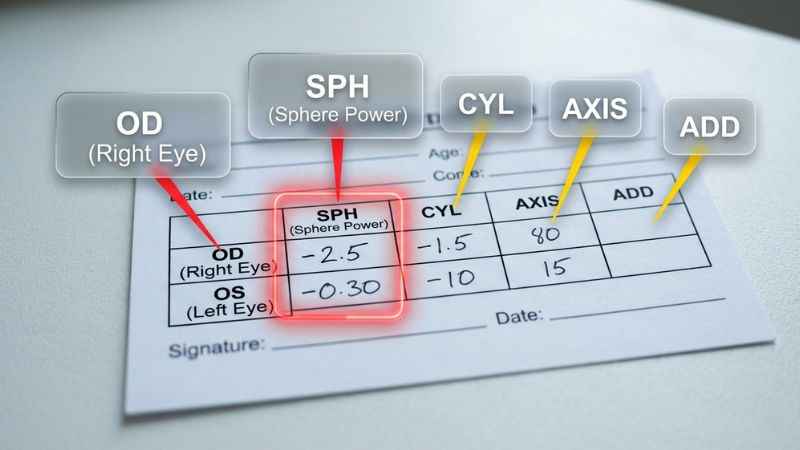
Your SPH value sits inside a grid of other numbers. To understand your full glasses prescription, you must read all fields together.
Example grid only—do not use these values to purchase eyewear:
| Eye | SPH | CYL | AXIS | ADD | Plain-English Reading |
| OD (Right) | −2.00 | −0.75 | 180 | — | Right eye needs −2.00 D sphere plus astigmatism correction. |
| OS (Left) | −1.50 | SPH | — | — | Left eye needs −1.50 D sphere with no astigmatism correction. |
| Both | — | — | — | +1.50 | Both eyes receive +1.50 D extra power for near reading. |
OD and OS: Which Eye Is Which?
Eye care professionals use Latin terms to identify each eye on paper:
- OD (Oculus Dexter): Your right eye.
- OS (Oculus Sinister): Your left eye.
- OU (Oculus Uterque): Both eyes.
Your SPH number can be different in each eye. For example, your right eye might be −2.00, while your left eye is −1.25. This difference is normal.
SPH vs. CYL vs. AXIS
Understanding how SPH interacts with other common prescription fields helps you read your prescription correctly:
[ SPH: Main Power ] + [ CYL: Astigmatism Power ] + [ AXIS: Angle ]
- SPH (Sphere): Corrects overall nearsightedness or farsightedness evenly across the lens.
- CYL (Cylinder): Corrects astigmatism, which is caused by an unevenly shaped cornea or lens inside the eye.
- AXIS: A number between 1 and 180 degrees. It shows the angle where your CYL power sits. CYL and AXIS must always appear together.
What ADD, Prism, and PD Mean
Other numbers on your prescription card relate to reading support or frame alignment:
- ADD: Extra plus power added to the bottom of progressive or bifocal lenses to help with reading up close.
- Prism: Specialized power measured in prism diopters. It aligns images for eyes that do not point straight together.
- PD (Pupillary Distance): The distance between the centers of your pupils in millimeters.
Power Fields vs. Fitting Fields Checklist:
- Power Fields: SPH, CYL, AXIS, ADD, Prism (These determine how your lens bends light)
- Fitting Fields: PD, Segment Height (These position the lens correctly inside your frame)
Special SPH Notations That Cause Confusion
Prescription forms vary by clinic. Some use numbers, while others write shorthand words inside the table columns.
What 0.00, Plano, or PL Means
If your prescription says 0.00, Plano, or PL under SPH, you do not need spherical distance correction in that eye.
However, you might still need glasses. An eye with a Plano SPH can still have CYL power for astigmatism, an ADD power for reading, or a Prism power for alignment.
What “SPH” in the CYL Box Usually Means
Sometimes the word “SPH” or “DS” (Diopter Sphere) is written inside the CYL column.
This simply means that eye has a spherical correction, but no astigmatism. It tells the optical shop to ignore the CYL and AXIS fields for that eye. If you find this notation confusing, double-check with your eye clinic before ordering lenses.
Why One Eye Can Be Plus and the Other Minus
It is possible to have a plus SPH in one eye and a minus SPH in the other. This condition is called anisometropia.
Each eye grows independently. One eye may focus light slightly in front of the retina, while the other focuses light behind it. Your optometrist or ophthalmologist adjusts each lens to help your brain combine both images clearly.
Glasses SPH vs. Contact Lens SPH
You cannot use an eyeglass SPH value to buy contact lenses.
Eyeglass lenses sit about 12 millimeters away from the surface of your eye. Contact lenses sit directly on your cornea. Because of this distance change—known as vertex distance—the required lens power often changes, especially for values stronger than 4.00 diopters.
Eyeglass Lens (Sits ~12mm away) ≠ Contact Lens (Sits directly on cornea)
Additionally, contact lens prescriptions require fitting information that eyeglasses do not have, including:
- Base Curve (BC): The curvature of the contact lens.
- Diameter (DIA): The physical width of the lens.
- Lens Material/Brand: The specific approved manufacturer.
Safety Warning: According to the American Academy of Ophthalmology (AAO), ordering contact lenses using an eyeglass prescription can cause blurry vision, eye strain, or serious corneal damage. Always get a separate contact lens fitting.
What SPH Does Not Tell You
While SPH explains your optical power, it leaves out critical information about your overall visual health.
SPH cannot tell you:
- Whether your eyes are healthy or free from conditions like cataracts or glaucoma.
- What your visual acuity is (such as 20/20 vision).
- How well your eyes work together as a team.
- Whether a specific frame size will fit comfortably on your face.
If you experience sudden vision loss, dark spots, flashes of light, severe eye pain, or sudden double vision, contact an eye care professional right away. Do not rely on prescription math to interpret sudden vision changes.
Common SPH Mistakes When Ordering or Comparing Glasses
Small errors can result in uncomfortable glasses that cause headaches or blurry vision. Review this checklist before buying eyewear online:
- Do not drop the plus or minus sign: Entering −2.00 as +2.00 ruins the lens function.
- Do not swap OD and OS: Ensure your right eye values match the OD row, and left eye values match the OS row.
- Do not swap SPH and CYL: Putting your cylinder power into the sphere box creates incorrect lenses.
- Do not mix up PD with SPH: Pupillary distance measures millimeter spacing, not focal power.
- Do not use expired prescriptions: Most optical prescriptions expire after one to two years, depending on local rules.
SPH Meaning FAQs
Is SPH the same as eye power?
Yes. SPH represents the main portion of your overall eye power. It measures the spherical power needed to correct basic nearsightedness or farsightedness across your lens.
What is a normal SPH value?
There is no medical “normal” value. An SPH of 0.00 or Plano means you require no spherical correction. Most visual corrections range between −6.00 D and +6.00 D.
Is a plus or minus SPH value better?
Neither is better. A minus sign simply indicates nearsightedness, while a plus sign indicates farsightedness. Both types of eyes can achieve crisp vision using properly fitted corrective lenses.
What does SPH −2.00 mean?
An SPH of −2.00 means you have mild nearsightedness. You need two diopters of minus power to see distant objects clearly, while close-up items usually remain easy to focus on.
What does SPH +0.75 mean?
An SPH of +0.75 indicates mild farsightedness. You need less than one diopter of plus power to help your eyes focus comfortably, especially during prolonged close-up reading.
Can SPH be zero?
Yes. SPH can be listed as 0.00, Plano, or PL. This means you do not need spherical power, though you might still need correction for astigmatism or reading.
Does SPH measure astigmatism?
No. SPH measures general spherical power. Astigmatism power is measured separately in the CYL (Cylinder) column, alongside an AXIS direction angle.
What does SPH mean in the CYL column?
Seeing “SPH” in the CYL column means your eye requires no astigmatism correction. Your lens only needs the primary spherical power listed in the SPH column.
What does SPH mean in slang?
Outside of medical optics, SPH can stand for “Sphinx” in gaming or “Sales Per Hour” in retail business settings. On any health document, it strictly means sphere power.
How often should I have my prescription checked?
You should schedule a comprehensive eye exam every one to two years. Regular exams ensure your SPH values are current and allow your doctor to screen for early health changes.
Sources and Next Steps
Medical Review: Reviewed for accuracy by an optical specialist.
References: Guidance on reading optical prescriptions from the American Academy of Ophthalmology (AAO).
Your Next Action: Locate your paper prescription card and find the SPH box. Double-check whether your number includes a plus (+) or minus (-) sign before using it to order new eyeglasses or schedule your next routine eye exam.
You May Also Like:
TPE Meaning: What It Stands For in Dating, Plastic, Medicine, and Travel
Mpreg Meaning: What the Fiction Tag Means

Joseph Quinn is the founder and editor of Punspa, a technology-focused website covering technology, website reviews, internet terms, and other things worth figuring out online. He writes and edits the site’s technology and web content, with a focus on clear, useful explanations. He also enjoys humor and wordplay, which occasionally leads him to write a pun-related article just for the fun of it.