In a text, what do i- mean in text usually means the sender started to write something, but they got too shocked, amused, or overwhelmed to finish. It mimics being cut off right in the middle of a sentence because words fail them.
This reaction shorthand appears in text messages, direct messages, and social-media comments. In its common slang use, I- is not a standard acronym; it usually represents a thought cut off mid-response. In some conversations, though, it could simply be an incomplete or mistyped message. Instead, it acts as a digital pause button for intense emotions.
What Does “I-” Mean?
In a text, I- usually signals that the sender is momentarily speechless, surprised, hesitant, or unsure how to continue. In informal texting, the dash is often used to suggest that the sender stopped mid-thought, similar to being unable to finish a response aloud.
People may use I- after something surprising, funny, awkward, or difficult to respond to. It can suggest that the sender is briefly too amused, embarrassed, shocked, or uncertain to complete their response.
The Four-Context Check
Because I- can convey more than one reaction, you should usually read it with the surrounding message and conversation context. You need to look at the clues surrounding the message to understand the sender’s true tone.

| Context Clue | What to Look For | Likely Meaning |
| Preceding Message | Wild news, a funny photo, or a bold statement | Genuine shock, laughter, or disbelief |
| Accompanying Emoji | 😭, 💀, or wide-eyes emoji | Heavy amusement, feeling dead from laughter, or shock |
| Relationship Dynamic | Close friends, romantic partners, or casual peers | Playful exaggeration or teasing banter |
| Continuation | Follow-up text sent right after the hyphen | The sender gathered their thoughts to explain |
Common Meanings Based on Pairing
Adding emojis or extra words completely shifts the vibe of the message. Here is how to decode the most common combinations you will see in group chats and DMs.
- I- 😭: I- 😭 often signals overwhelming emotion—commonly laughter or dramatic amusement online, but sometimes sadness, frustration, or being emotionally moved.
- I- 💀: I- 💀 often means “I’m dead” in a figurative sense—commonly from laughter, disbelief, embarrassment, frustration, or overwhelm.
- I- what?: I- what? commonly expresses confusion, surprise, or disbelief and may invite clarification.
- I- never mind: I- never mind may show that the sender started a thought and then chose not to continue; the reason could be awkwardness, uncertainty, or a change of mind.
- I- after a compliment: After a compliment, I- can suggest that the sender feels flustered, surprised, or unsure how to respond.
I- vs. I… vs. I Can’t
Many text slang terms look similar, but they carry distinct nuances in digital body language.
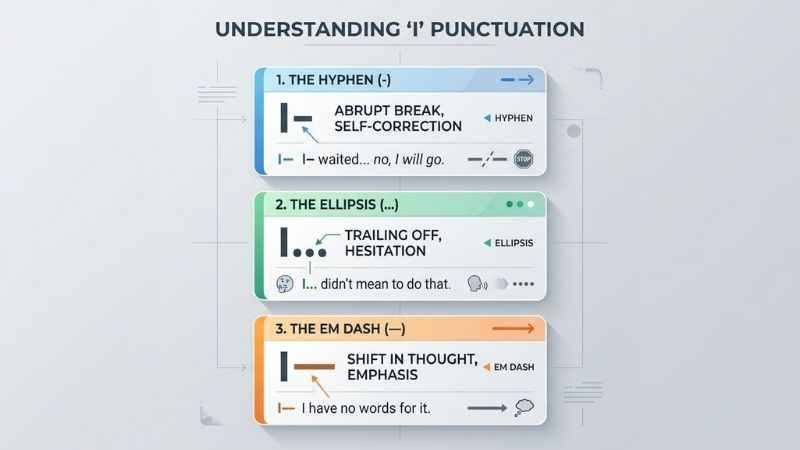
| Expression | Primary Vibe | How It Differs From I- |
| I- | Cut off by shock or a sudden reaction | I- often uses a hyphen-like dash informally to suggest an abrupt stop in the response |
| I… | Trailing off in confusion or hesitation | I… often suggests a trailing thought, pause, hesitation, or uncertainty; its tone depends on context |
| I— | Dramatic, heavy interruption | I— can be used informally to make an interruption or pause look more emphatic; formally, an em dash has broader punctuation uses |
| I can’t | Fully formed declaration of helplessness | I can’t is a more explicit reaction phrase that can signal overwhelm, laughter, disbelief, frustration, or literal inability, depending on context |
Frequently Asked Questions
Does “I-” mean the sender is speechless?
Yes, it usually means the sender is momentarily at a loss for words. They felt too stunned or amused to finish their original sentence.
Is “I-” rude in a text?
I- is often used as an informal reaction rather than a direct insult, but it can come across as teasing, judgmental, dismissive, or awkward depending on the context.
What does “I-” mean from a crush or friend?
From a crush or friend, I- can signal shock, amusement, teasing, awkwardness, or hesitation; interpret it from the preceding message and the relationship’s usual tone. Do not rely on the sender’s gender to interpret I-; the surrounding conversation and relationship context are more useful clues.
Is “I-” the same as “I can’t”?
I- and “I can’t” can both appear in reactions to something funny, shocking, or overwhelming, but they are not interchangeable in every context. “I-” uses a punctuation mark to show an abrupt stop, while “I can’t” spells out the feeling in plain words.
How should I reply to “I-”?
You can reply by asking what they meant, sending a laughing emoji, or waiting for them to finish their thought in the next message.
Can I use “I-” at work or in a formal message?
In formal, customer-facing, academic, or high-stakes professional communication, avoid I- because its informal and context-dependent tone may be unclear. In casual internal chats, follow your organization’s communication norms.
A useful next step is to check the preceding message and any emoji attached to it for clues about the sender’s likely tone.
You May Also Like:
Ion Meaning in Text: What “Ion” Means and How to Tell From Context
No Mames Meaning: What It Means, How Strong It Is, and When to Use It

Joseph Quinn is the founder and editor of Punspa, a technology-focused website covering technology, website reviews, internet terms, and other things worth figuring out online. He writes and edits the site’s technology and web content, with a focus on clear, useful explanations. He also enjoys humor and wordplay, which occasionally leads him to write a pun-related article just for the fun of it.