Looking for information on kingkendama.com? This guide explains what the website offers, how to check if a kendama site is safe, and how to pick the right skill toy for your budget. We will also clear up confusion between kingkendama.com and other similarly named brands, then show you how to learn your first tricks step by step. Note that website ownership, prices, and stock can change over time, so always check live policies before buying.
What Is KingKendama.com?
Understanding kingkendama.com starts with looking at what the domain actually shows to visitors. Many online readers search for this name to see if it is a store, a review site, or a general news publication.
Website purpose and content
When you search for kingkendama.com, current indexed pages show general blog content covering several topics rather than a clearly defined kendama store or business.
It is important to know what kind of site you are visiting:
- Retailer: A store that holds inventory, processes payments, and ships physical products directly to your door.
- Publisher: A site that writes guides, news stories, and trick tutorials without selling physical goods.
- Affiliate site: A blog that reviews products and sends you to outside stores like Amazon or specialized shops through referral links.
Because indexed pages cover unrelated topics, check the current homepage before trusting any product or payment claim.
KingKendama.com versus similarly named brands
It is very easy to confuse kingkendama.com with other popular shops and brands. The table below shows how these names differ so you do not buy from the wrong seller.
| Entity | What it appears to be | Why users may confuse it |
| kingkendama.com | Website domain under review | Matches the exact phrase people search |
| Kendama King Australia | Australian retailer and community brand | Shares the words “Kendama” and “King” |
| KIN Kendamas | KIN Kendamas is a separate international kendama brand based in Belgium | Uses a short name that sounds similar |
| Kendama USA | Kendama USA is a U.S.-based kendama retailer and manufacturer | Shows up in the same online search results |
| eBay “King Kendama” listings | Marketplace listings may come from third-party sellers. Check the seller on each listing. | Uses “king” as a descriptive word for large toys |
Note: Business details, locations, and product lines can change. Always confirm who operates the checkout page.
What the site does not establish automatically
A web domain name alone does not tell you everything about a business. Just because a website uses the name kingkendama.com, it does not automatically mean:
- It is an official product factory or original manufacturer.
- It carries genuine stock from top world brands.
- Its authors have tested every product in person.
- It offers full money-back guarantees or fast local shipping.
Taking a few extra seconds to review a site protects your money and personal data.
Is KingKendama.com Legit and Safe to Use?
Before you shop on kingkendama.com or any new website, you should evaluate its trustworthiness. You can check a few clear signals in your browser to spot safe online stores.
Website verification checklist
Use this quick checklist to test any site before entering your credit card details:
- [ ] Secure connection: Look for
https://and a closed padlock icon in your browser bar. - [ ] Real contact info: Check for a real email address, phone number, and physical office address.
- [ ] Clear policy pages: Look for links to a privacy policy, terms of service, and refund details.
- [ ] Transparent pricing: Confirm that shipping fees and taxes are clearly listed before checkout.
- [ ] Payment options: Look for trusted payment methods like standard credit cards or PayPal.
- [ ] Working links: Click social media icons to see if they lead to active community pages.
How to interpret reviews and recommendations
When reading product reviews on kingkendama.com or forum sites like Reddit, keep in mind that not all feedback is the same:
- First-party claims: Statements made by the seller. These are meant to market the product.
- Hands-on reviews: Articles or videos by players who tested the toy for several weeks.
- User comments: Personal opinions on discussion boards. These show individual experiences but may not tell the whole story.
- Affiliate links: Recommendations where the writer earns a small fee if you buy the item.
What to verify before placing an order
Before You Buy:
Always verify the total price, shipping origin, estimated delivery time, and return conditions. Check if customer support responds to a simple pre-sale email. If a site lacks contact information or refuses to list a refund policy, hold off on your purchase.
What Is a Kendama and How Does It Work?
A kendama is a Japanese cup-and-ball skill toy with a ken, cups, spike, tama, and string. Playing kendama requires hand-eye coordination, balance, timing, and patience. The Japan Kendama Association publishes kendama information, skill tests, and competition guidance.
         [Spike]
            ||
      (Small)  (Big)  <-- Sarado (Crosspiece)
          \ || /
         [Base Cup]
            ||
          [Ken]  <================>  [Tama] (Ball)
                                      (Hole on bottom)
The main kendama parts
Most standard kendamas share these core parts. Learning these terms makes it much easier to follow trick tutorials.
| Part | Japanese Term | Function |
| Handle | Ken | The main wooden stick you hold during basic play. |
| Ball | Tama | The tama is the ball with a hole used for spike catches and balance tricks. |
| Crosspiece | Sarado | The center wooden piece that holds the side cups. |
| Big cup | Ōzara | The largest cup on the side, best for beginner catches. |
| Small cup | Kozara | The smaller side cup opposite the big cup. |
| Base cup | Chūzara | The chūzara is the medium or base cup on the reverse side of the sarado. |
| Spike | Kensaki | The pointed tip at the top used to catch the ball hole. |
| String | Ito | The strong cord connecting the ball to the handle. |
Why kendama is harder than it looks
Catching a wooden ball on a flat cup seems simple, but getting the balance right takes control. Beginners often fail because they rely only on their hands and wrists.
To land catches consistently, you must track the ball with your eyes, control the tilt of the handle, and bend your knees. Your legs act like shock absorbers. Bending your knees softens the impact so the wooden ball stays in the cup instead of bouncing out.
How to Choose the Right Kendama
Finding the right setup depends on your current skill level, your budget, and the types of tricks you want to learn.
       BEGINNER SETUP                       ADVANCED SETUP
+----------------------------+       +----------------------------+
| * Larger cups for catches  |       | * Precise weight balance   |
| * Sticky / Tacky paint     |       | * Durable hardwood (Maple) |
| * Flexible Beech wood      |       | * Long string for juggles  |
+----------------------------+       +----------------------------+
Beginner versus advanced shape
Modern manufacturers make different shapes for different skill levels:
- Beginner shapes: Some beginner models use larger cups, larger tamas, or wider spikes. These forgiving dimensions give you a larger target when landing your first catches.
- Advanced shapes: Some advanced models offer different balance features, bevels, shapes, or longer strings. These features help experienced players perform complex flips, juggles, and balance tricks like lighthouses.
Sticky, tacky, rubber, and clear finishes
The paint on the ball plays a major role in how the toy performs:
- Sticky or tacky paint: Sticky paint may make some balance tricks easier, but it is not required for beginners. It can help some beginners, but basic shape and comfort also matter.
- Rubber or silk paint: Rubber and silk finishes have different feels. Durability depends on the product and use.
- Clear coat or natural wood: Unpainted or clear finishes can feel different and may offer less grip.
Wood types and durability
Different woods offer distinct sounds, weights, and levels of durability:
- Beech: Beech is a common wood that is relatively soft and breaks in with play. It is often used in entry-level kendamas.
- Maple: Maple is a dense hardwood, but durability depends on the model and how it is used.
- Ash: Features deep wood grain lines that provide texture and a unique look.
Standard, large, mini, and king-size kendamas
Size changes how you play and practice:
- Standard size: Standard kendamas are usually about 7 to 7⅜ inches tall. Some standard-size kendamas are approved for JKA tests and competitions, and fit comfortably in most hands.
- Large or king-size: Features a much bigger handle and ball. Large cups make catches easier to see during group shows, but large models may feel heavier and may require more effort, depending on their design.
- Mini size: Fits in a pocket for easy travel, but mini kendamas have smaller targets and may be harder for many beginners.
Product selection matrix
Use this table to match your player profile with the best setup features:
| Player type | Features to prioritize | Features to avoid |
| Complete beginner | Wide cups, sticky paint finish, beech wood | Tiny cups, slick natural wood, very heavy setups |
| Casual player | Balanced shape, durable rubber coat, standard size | Flashy novelty shapes that break easily |
| Trick-focused player | Tacky finish, long string, center weight hole | Short strings that restrict hand movement |
| Advanced player | Advanced players may choose wood, finish, shape, and weight based on personal preference. | Soft woods that chip quickly under hard use |
| Gift buyer | Entry-level kit, replacement string included | Unlabeled mystery brands without contact support |
Beginner Kendama Tricks and Practice Progression
Starting with the right techniques builds good habits and stops bad form before it starts.
The basic stance and knee rhythm
Before attempting your first trick, stand with your feet shoulder-width apart. Keep your shoulders relaxed and hold the handle at chest level.
Follow this simple three-part rhythm on every pull-up:
- Bend your knees to drop your center of gravity.
- Push up with your legs to lift the ball straight into the air without spinning it.
- Bend your knees again as the ball lands to cushion the catch quietly.
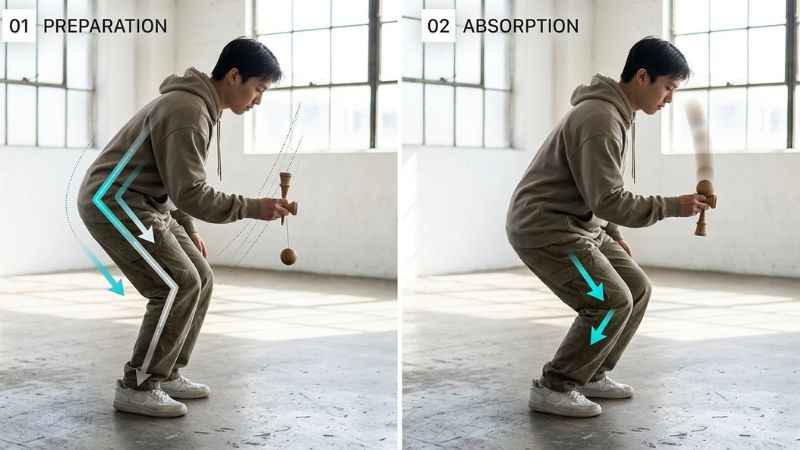
Big cup, small cup, and base cup
- Big cup (Ōzara): Hold the handle with your dominant hand like a pen. Bend your knees, pull the ball straight up, and guide the big cup underneath it. Sink down with your knees as it lands.
- Small cup (Kozara): Turn your wrist slightly inward so the smaller cup faces upward. Pull the ball straight up using your legs and cushion the catch.
- Base cup (Chūzara): Turn the handle upward so the bottom cup faces the ceiling. Pull the ball up smoothly and catch it on the base cup.
       BIG CUP                SMALL CUP               BASE CUP
    (Widest target)        (Slightly smaller)      (Bottom target)
         \                  /                          |
          v                v                           v
       +-----+          +-----+                     +-----+
       |     |          |     |                     |  |  |
       +-----+          +-----+                     +-----+
          |                |                           |
          |                |                        +-----+
                                                    |     |
                                                    +-----+
Spike catch
Landing the ball on the pointed spike requires control over ball rotation:
- Hold the handle with the spike pointing straight up.
- Let the ball hang completely still beneath the handle.
- Pull the ball straight up. Control the tama’s rotation and keep the hole facing the spike.
- Watch the hole as the ball reaches its highest point.
- Guide the spike directly under the hole and drop your knees to lock the catch in place.
Airplane and Around Japan
Once you master the basic cups and spike, move on to these classic combinations:
- Airplane: Hold the ball in your hand and let the handle hang below. Swing the handle out gently, pull it back toward you, and catch the incoming spike inside the ball hole.
- Around Japan: One common version is to land the ball on the big cup, toss it up to catch on the small cup, toss it up again to catch on the base cup, and finish with a spike catch.
A simple practice routine
Spend 20 minutes a day following this warm-up schedule:
- 5 minutes: Big cup pull-ups (suggested practice target: 10 catches in a row).
- 5 minutes: Alternating between small cup and base cup.
- 5 minutes: Still-ball spike practice.
- 5 minutes: Combined trick practice (like Around Japan).
Common Kendama Problems and How to Fix Them
It is normal to run into trouble when learning new tricks. Here is how to correct common errors.
| Problem | Cause | Solution |
| Ball misses the cup | Moving arm too fast | Lift with your knees |
| Spike catch fails | Ball is spinning | Control tama rotation |
| Ball slips off balance | Slick finish | Use the maker’s cleaning advice |
The ball keeps missing the cup
- The cause: You are pulling the ball up using your arm instead of your legs. This makes the ball fly wildly sideways.
- The fix: Keep your elbow close to your body. Let your legs do the lifting, and focus your eyes on the ball pattern as it rises.
The spike catch fails
- The cause: The ball spins in the air, hiding the hole from view.
- The fix: Control the tama’s rotation and keep the hole facing the spike before pulling up. Keep your pull smooth and vertical so the hole stays facing the floor.
Balance tricks feel impossible
- The cause: Dust or dirt on the ball surface is reducing grip, or the string length is incorrect.
- The fix: Use the maker’s cleaning advice. Do not add moisture unless the maker allows it. String length varies. JKA suggests about 38–40 cm, and players may adjust it.
String, paint, or wood problems
- Frayed string: Replace a string when it is frayed or damaged.
- Chipped paint: Small chips are normal over time. Do not sand chips unless the maker gives repair instructions. Remove or replace damaged parts when needed.
- Warped wood: Store wood away from damp conditions and follow the maker’s care advice. Never submerge your toy in water.
Kendama Care, Storage, and String Replacement
Taking care of your equipment keeps it performing smoothly for months.
Cleaning and storage
- Wipe down your setup with a dry cloth after long practice sessions to remove hand oils.
- Store your toy indoors away from damp areas, extreme heat, and direct sunlight.
- Avoid dropping the wood on hard concrete, which can flatten the spike tip quickly.
When to replace the string
Swap in a new cord if you notice:
- Fraying near the knot inside the ball or handle.
- Heavy stretching that makes the string feel thin.
- Knots that cannot be untangled.
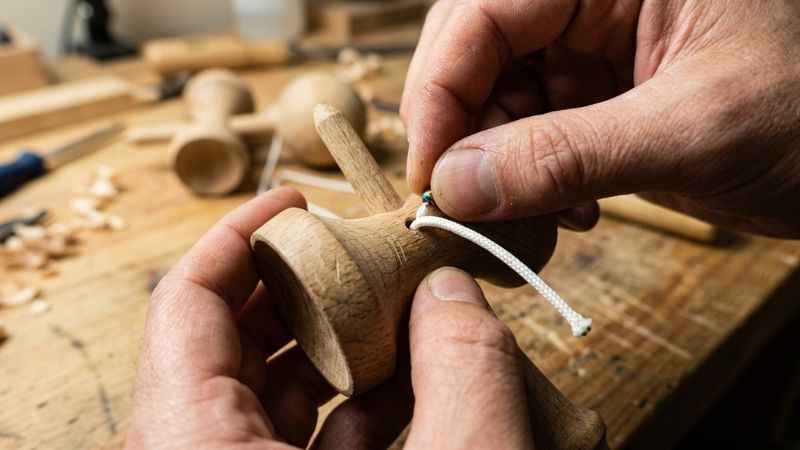
Basic string replacement steps
- Follow the maker’s stringing instructions for your model.
- Tie a double knot at the end and pull it tight inside the ball cavity.
- Thread the string through the model’s designed string path.
- Pass the cord through the tiny bead or plastic ring.
- Tie a secure end knot, test the length, and cut off any extra string.
How KingKendama.com Compares With Other Kendama Sources
When looking for trustworthy information or products, it helps to compare kingkendama.com against established shops and community hubs.
Comparison criteria
To evaluate any vendor or review site, look at these core factors:
- Product selection: Does the site offer a wide variety of shapes, woods, and finishes?
- First-hand testing: Does the site show original photos and clear testing methods?
- Brand transparency: Is it clear who owns the site and where products ship from?
- Customer support: Are refund rules, delivery timelines, and contact details clear?
Avoiding unsupported claims
Be careful with sites that claim to sell the single “best” model on the market. The ideal toy always depends on your personal preferences, your skill level, and your budget. Specialized retailers like Kendama USA and Sweets Kendamas share product information on their official sites.
When reviewing kingkendama.com or any new online shop, look for those same transparent features before placing an order.
Frequently Asked Questions About KingKendama.com
What is KingKendama.com?
Current search results show general content on the domain. Its kendama offerings are unconfirmed. Because web ownership and content can change over time, readers should check the homepage directly to confirm its current offerings.
Is KingKendama.com the same as Kendama King Australia?
No. Kendama King Australia is an Australian kendama retailer with community activities. Kingkendama.com is a separate web address, so do not assume they share the same stock, owners, or support teams.
Does KingKendama.com sell kendamas directly?
That depends on the site’s current setup. It may operate as an online shop, a blog with referral links, or an informational portal. Check for a shopping cart and checkout system to see if direct sales are active.
Is KingKendama.com safe to buy from?
You can verify its safety by checking for an HTTPS connection, clear refund policies, valid contact details, and secure checkout options like credit cards or PayPal. Avoid sites that hide their business details.
What is the best kendama for a beginner?
Many beginners prefer a forgiving shape, but wood and finish are personal choices.
How much should a beginner kendama cost?
Entry-level prices vary by brand, model, and market. Check current listings before buying.
Is sticky paint better for learning tricks?
Sticky paint may help with some balance tricks, but it is not required for basic learning.
What are the easiest kendama tricks to learn first?
The easiest starting tricks are the big cup, small cup, base cup, and still-ball spike catch. Mastering these basic moves builds the foundation for harder trick combinations.
How often should a kendama string be replaced?
Replace the string when it is frayed, stretched, or damaged.
Can children play kendama safely?
Use the maker’s age label and supervise children. Play in a clear space away from breakable items, windows, and other people.
How We Evaluate Kendama Information and Products
We evaluate skill toys and buyer guides using clear research standards:
- Evaluation process: We assess products based on play balance, wood durability, paint grip, and string strength.
- Information checks: We confirm terminology and trick steps using references from official organizations such as the Japan Kendama Association.
- Transparent disclosures: If a product link earns a commission or if an item was gifted for review, we disclose that clearly to our readers.
- Editorial standards: We aim to keep our guides accurate and reliable as new information becomes available.
You May Also Like:
Madeonverse.com Spotify: How to Create Your Spotify Bedroom (Step-by-Step Guide)
Heartymag.com Review: Is It Safe for Guest Posts & Backlinks?

Joseph Quinn is the founder and editor of Punspa, a technology-focused website covering technology, website reviews, internet terms, and other things worth figuring out online. He writes and edits the site’s technology and web content, with a focus on clear, useful explanations. He also enjoys humor and wordplay, which occasionally leads him to write a pun-related article just for the fun of it.