What does TPE stand for? The answer depends entirely on where you see it. TPE has several meanings; common ones include thermoplastic elastomer in materials engineering, Total Power Exchange in relationship dynamics, therapeutic plasma exchange in healthcare, and codes associated with Taiwan or Chinese Taipei in travel and sports.
Because these fields have nothing in common, the surrounding words are your best tool to figure out which TPE meaning someone is using.
| Context | TPE Stands For | Plain-English Meaning | Common Context Clues |
| Products & Manufacturing | Thermoplastic elastomer | A family of materials that combines thermoplastic processability with elastomeric, rubber-like properties; exact performance varies by formulation | Material, plastic, rubber, injection molding, Shore hardness |
| Dating & Relationships | Total Power Exchange | In BDSM and relationship communities, TPE is commonly used to describe a consensual power-exchange dynamic | D/s, dominant, submissive, 24/7, relationship agreement |
| Healthcare & Medicine | Therapeutic plasma exchange | A clinical treatment that removes a patient’s plasma and replaces it with an appropriate replacement fluid while returning cellular blood components | Apheresis, plasma, antibodies, clinical procedure |
| Travel & Sports | Airport & Sports Codes | In aviation, TPE is the IATA airport code for Taiwan Taoyuan International Airport. In Olympic usage, TPE is the code associated with Chinese Taipei | Airport, flight, IATA, Chinese Taipei, Olympics |
What does TPE mean?
Depending on context, TPE can mean thermoplastic elastomer, Total Power Exchange, therapeutic plasma exchange, Taiwan Taoyuan International Airport, or Chinese Taipei in Olympic usage.
                  ┌──► Thermoplastic Elastomer (Manufacturing / Plastics)
                  │
                  ├──► Total Power Exchange (Dating / Relationships)
What does TPE ────┼
 mean to you?     ├──► Therapeutic Plasma Exchange (Medical Treatment)
                  │
                  └──► Airport & Sports Codes (Travel / Chinese Taipei)
No single definition of TPE is correct for every situation. Acronyms save space in text messages, clinical charts, and product catalogs. As a result, different industries independently created the same short label.
These are several common meanings, but specialized uses also exist, such as the Medicare Targeted Probe and Educate program used in American healthcare administration.
TPE meaning in dating, chat, and BDSM
In BDSM and relationship communities, TPE is commonly used to describe a consensual power-exchange dynamic where partners agree to share authority over daily decisions, routines, or personal roles.
What Total Power Exchange means
TPE is a term used in some BDSM and D/s communities for an extensive consensual power-exchange dynamic. Some people use TPE to describe a power-exchange arrangement extending beyond individual scenes and into agreed aspects of daily life.
TPE is not a synonym for domestic abuse, coercion, or total loss of personal autonomy. Consent educators commonly emphasize ongoing consent, explicit boundaries, communication, and the ability to stop or change agreements.
How TPE differs from D/s and 24/7 dynamics
People often mix up basic D/s, 24/7 D/s, and TPE. While they are related, the terms overlap in community usage. People may use TPE for a broader negotiated scope of authority, but definitions and boundaries vary by relationship.
| Dynamic Type | Scope of Authority | How It Works in Practice |
| Scene-Based D/s | Limited to specific times | Power structure only applies during agreed activities or scenes. |
| 24/7 D/s | Ongoing daily structure | A 24/7 D/s arrangement may extend dominant/submissive roles into daily life; the scope of authority over routines or major decisions varies by agreement. |
| Total Power Exchange (TPE) | Negotiated authority | The term is often used for a broad or intensive consensual authority-exchange arrangement, with scope defined by the people involved. |
Consent, communication, and boundaries
Any relationship involving power exchange requires clear ground rules to protect both people:
- Informed, adult consent: Both partners must fully understand and freely agree to every part of the arrangement without pressure.
- Negotiated limits: Partners explicitly discuss what is included in the dynamic and what remains completely off-limits.
- Revocable authority: People should be able to communicate a pause, change, or withdrawal of consent. Partners may use safewords, check-ins, or other pre-agreed communication methods.
- Open communication: Regular check-ins ensure the dynamic remains healthy, safe, and positive for everyone involved.
- Outside support: Neither partner should isolate themselves from family, friends, or medical care.
Safety Warning: Forced or non-consensual control is abusive. A relationship label does not excuse coercion, threats, isolation, or denial of a person’s ability to seek help or end participation.
How to interpret TPE on a dating profile or in chat
If you see “TPE” listed on a dating profile, the person is indicating an interest in structured power-exchange dynamics.
┌─────────────────────────────────────────────────────────┐
│ DATING PROFILE CONTEXT CLUES                            │
├─────────────────────────────────────────────────────────┤
│ "Looking for a 24/7 D/s dynamic, open to TPE..."       │
│  ↳ Meaning: Total Power Exchange (BDSM dynamic)         │
└─────────────────────────────────────────────────────────┘
If you are unsure what someone means in a conversation, ask directly in simple words: “Are you using TPE to mean Total Power Exchange, or something else?” Clear communication prevents misunderstandings.
TPE material meaning: thermoplastic elastomer
In engineering, product design, and manufacturing, TPE stands for thermoplastic elastomer. TPEs are a family of synthetic materials that combine the elastic flexibility of rubber with the easy processing of plastic.
┌─────────────────────────────────────────────────────────┐
│ MATERIAL SPECIFICATION CONTEXT CLUES                    │
├─────────────────────────────────────────────────────────┤
│ "Handle grip: Molded TPE, 60 Shore A hardness..."       │
│  ↳ Meaning: Thermoplastic Elastomer (Flexible Plastic)  │
└─────────────────────────────────────────────────────────┘
What makes TPE different from ordinary plastic and rubber
Many conventional rubbers are chemically cross-linked—often through vulcanization—which generally prevents them from being remelted and reshaped like thermoplastics. Many rigid plastics can be heat-processed, but they generally do not recover from large elastic deformation in the same way elastomers do.
TPEs bridge this gap. Many TPE grades can be softened or melt-processed for molding and may be reprocessed under suitable controlled conditions; recyclability depends on the specific formulation and waste stream.
Where thermoplastic elastomers are used
TPE grades can be formulated across a range of hardness, durability, and color options, making them suitable for many consumer and industrial applications:
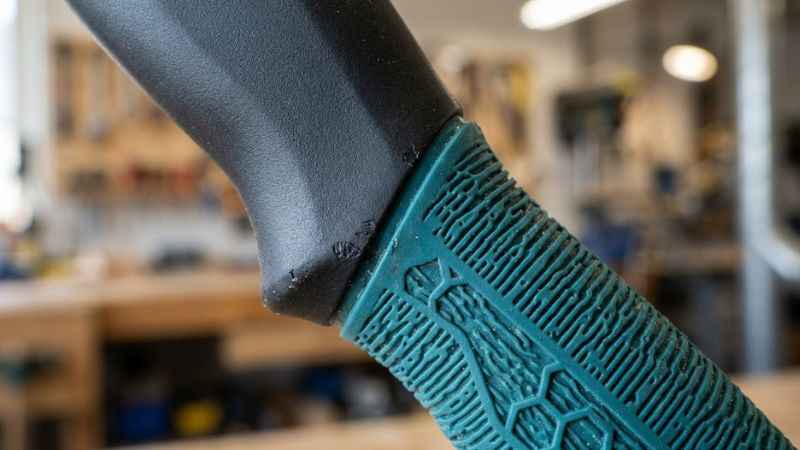
- Tool and appliance handles: TPEs are used for grips and handles, including applications such as hand tools and other soft-touch consumer-product components.
- Automotive parts: TPEs are used across automotive applications, including interior, exterior, and engine-related components; suitability depends on the specific grade and performance requirements.
- Consumer electronics: Some TPE materials are used in electronics, including cable coatings, fillings, and related flexible components.
- Medical devices: Certain TPE grades are used in medical and fluid-delivery applications, including blood-transfer infusion kits and related healthcare components.
TPE vs. TPR vs. silicone
Designers often compare TPE against thermoplastic rubber (TPR) and liquid silicone rubber.
| Feature | TPE (Thermoplastic Elastomer) | TPR (Thermoplastic Rubber) | Silicone |
| Material Class | Broad family of flexible polymers | TPR, or thermoplastic rubber, is commonly used as a label for rubber-like thermoplastic materials and may be treated as a subset or market term within the broader TPE category; precise chemistry varies by supplier and grade | Silicone is a class of synthetic polymers with a siloxane backbone of alternating silicon and oxygen atoms, usually bearing organic side groups |
| Processing | Easy injection molding | Easy injection molding | Many silicone elastomers are cured or cross-linked during processing. Liquid silicone rubber is a specific form that is typically injection-molded and cured; curing conditions vary by formulation |
| Flexibility & Feel | Very soft to medium-rigid | Rubber-like, high grip | Exceptionally smooth and flexible |
| Heat Resistance | Heat resistance varies widely by TPE family and grade. Cite the manufacturer’s datasheet for the selected compound rather than using one universal temperature | TPR heat resistance varies by composition and supplier grade; use grade-specific technical data | Many silicone elastomers offer higher temperature resistance than common TPE grades, but the applicable service temperature must be confirmed from the specific product datasheet |
| Recyclability | Many TPEs can be reprocessed and may be recyclable, but practical recyclability depends on the specific material and waste stream | For any TPR-labelled material, confirm reprocessing and recycling options with the supplier’s technical and sustainability documentation | Cured silicone elastomers are cross-linked and generally cannot be remelted and remolded like thermoplastics |
What to check before choosing a TPE material
When selecting a material for a product, engineers look at specific attributes:
- Hardness scale: Measured on the Shore scale (such as Shore A for soft items or Shore D for semi-rigid items).
- Chemical exposure: Check if the material will contact oils, grease, or harsh cleaning chemicals.
- Temperature limits: Ensure the product will not deform under summer heat or freeze into a brittle state.
- Regulatory approvals: For medical, food-contact, and children’s products, determine the applicable jurisdiction, intended use, relevant material regulations, and required testing, documentation, registration, clearance, or approval. Do not describe these collectively as FDA “certifications.”
TPE medical meaning: therapeutic plasma exchange
In hospitals and medical charts, TPE stands for therapeutic plasma exchange. Therapeutic plasma exchange removes a patient’s plasma, which may contain disease-associated substances, and replaces it with an appropriate replacement fluid while returning cellular blood components.
┌─────────────────────────────────────────────────────────┐
│ MEDICAL CHART CONTEXT CLUES                             │
├─────────────────────────────────────────────────────────┤
│ "Patient scheduled for TPE via apheresis line..."       │
│  ↳ Meaning: Therapeutic Plasma Exchange (Procedure)     │
└─────────────────────────────────────────────────────────┘
What happens during therapeutic plasma exchange
TPE is performed using an apheresis system and vascular access selected by the clinical team, which may be peripheral or central.
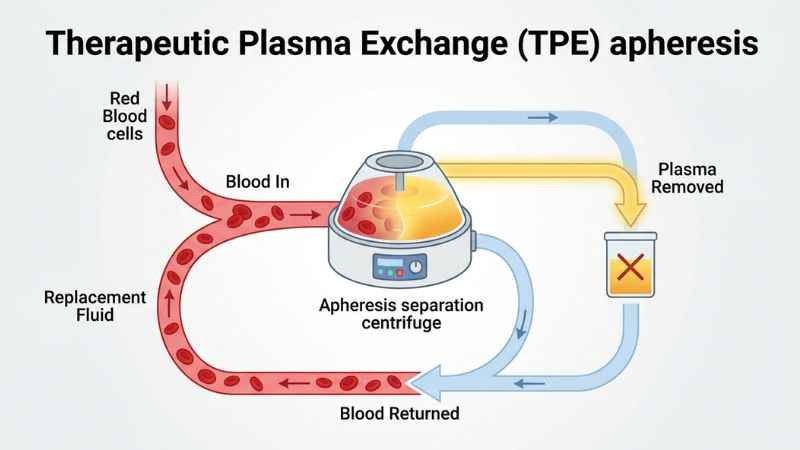
  [ Patient Blood Out ] ──► [ Apheresis Filter ] ──┬──► [ Harmful Plasma Removed ]
                                                 │
  [ Patient Blood In  ] ◄── [ Recombined Blood ] ◄─┴── [ Replacement Fluid Added ]
- Blood is drawn out of the body in small amounts.
- The machine separates the liquid portion of the blood (plasma) from the red blood cells, white blood cells, and platelets.
- The separated plasma is removed and discarded; depending on the indication, it may contain substances the care team aims to reduce, such as pathogenic antibodies or other plasma-borne factors.
- The cellular blood components are returned with a prescribed replacement fluid, commonly albumin solution, donor plasma, or a combination depending on the clinical indication.
Why a clinician may use TPE
Clinicians may use TPE for selected conditions involving disease-associated plasma components, such as certain antibodies or proteins. Indications and replacement fluids are determined by specialist assessment and current clinical guidance. For selected conditions, TPE is used to reduce circulating plasma components thought to contribute to disease. Its role varies by diagnosis and should be determined by specialists. TPE is a clinician-directed procedure performed by trained healthcare teams using specialized apheresis equipment.
TPE, plasmapheresis, and dialysis: are they the same?
TPE and plasmapheresis are closely related terms, although some technical sources distinguish plasma removal from plasma removal with replacement. Hemodialysis is a distinct treatment used primarily to replace kidney filtration functions.
| Medical Term | What It Separates | Primary Goal |
| Therapeutic Plasma Exchange (TPE) | Removes whole plasma from blood cells | Removes large pathogenic molecules, such as autoantibodies and circulating toxins |
| Plasmapheresis | Plasmapheresis broadly refers to separating or removing plasma | In some technical usage, TPE refers specifically to removal of a clinically significant plasma volume with replacement fluid |
| Hemodialysis | Filters low-molecular-weight waste and extra water | Hemodialysis replaces some kidney filtration functions by removing waste products and excess fluid and helping manage electrolyte and acid-base balance |
TPE in travel, sports, and workplace acronyms
Beyond materials, dating, and healthcare, TPE serves as a shorter code name in travel logistics, international sports, and government administrative programs.
TPE airport code
In aviation, TPE is the IATA airport code for Taiwan Taoyuan International Airport. Taiwan Taoyuan International Airport serves the Taoyuan/Taipei metropolitan area and handles international flights.
┌─────────────────────────────────────────────────────────┐
│ TRAVEL ITINERARY CONTEXT CLUES                          │
├─────────────────────────────────────────────────────────┤
│ "Flight 402 departing LAX arriving TPE..."              │
│  ↳ Meaning: Taiwan Taoyuan International Airport        │
└─────────────────────────────────────────────────────────┘
TPE and Chinese Taipei
In Olympic contexts, Chinese Taipei is the official National Olympic Committee designation; verify the applicable federation or event’s code list before stating that TPE is its official code.
CMS Targeted Probe and Educate
In U.S. healthcare administration, TPE stands for Targeted Probe and Educate. Run by the Centers for Medicare & Medicaid Services (CMS), this compliance program helps medical billing providers reduce claim denial rates through audited reviews and direct education.
Other regional uses
Occasionally, TPE refers to regional infrastructure or companies.
How to tell which TPE meaning applies
You can quickly figure out the right meaning of TPE by following three simple steps:
Step 1: Identify the source domain (Medical chart, travel app, plastic tool, dating app).
Step 2: Scan for matching words (Shore hardness, apheresis, flight number, 24/7 D/s).
Step 3: Match the clues to the correct expansion using the guide below.
- Check the source: Notice where you found the letters. These contexts can offer strong clues, but readers should still check nearby terms and the source domain before deciding which expansion applies.
- Scan for adjacent keywords: Look at the words surrounding the acronym.
- Match the clues:
- “TPE 70 Shore A” $\rightarrow$ Thermoplastic Elastomer
- “TPE dynamic, limits, consent” $\rightarrow$ Total Power Exchange
- “Ordered for TPE via central line” $\rightarrow$ Therapeutic Plasma Exchange
- “Flight to TPE” $\rightarrow$ Taiwan Taoyuan International Airport
Frequently asked questions about TPE
What does TPE mean in dating?
In dating, TPE stands for Total Power Exchange. It describes an adult relationship dynamic where partners negotiate agreements about shared authority, control, and personal roles based on voluntary consent.
What does TPE mean in chat or slang?
In chats about BDSM or relationship dynamics, TPE commonly means Total Power Exchange; in other conversations, it may refer to material, medical, travel, or workplace meanings.
Is TPE the same as 24/7 D/s?
Not quite. The terms overlap in community usage. People may use TPE for a broader negotiated scope of authority, but definitions and boundaries vary by relationship.
Is TPE the same as TPR or silicone?
No. TPE is a broad family of flexible plastics. TPR is a common industry label often used for styrenic block copolymer TPEs. Silicone is a separate class of synthetic polymers with a siloxane backbone that requires chemical curing and cannot be remelted once fully set.
What does TPE mean at an airport?
In aviation, TPE is the IATA airport code for Taiwan Taoyuan International Airport.
Is therapeutic plasma exchange the same as dialysis?
No. Dialysis replaces kidney filtration functions by filtering low-molecular-weight metabolic waste and excess fluid from blood. Therapeutic plasma exchange specifically removes whole blood plasma to discard harmful autoantibodies or proteins before returning the blood cells.
What does CMS TPE mean?
In medical billing, CMS TPE stands for Targeted Probe and Educate. It is an educational review program run by Medicare to help health providers fix billing errors and improve claim accuracy.
To confirm which meaning applies to your situation, double-check the surrounding keywords or ask the person who wrote it. If you need deeper details on polymer engineering, clinical blood procedures, or relationship safety, consult a material engineer, healthcare provider, or licensed relationship professional.
You May Also Like:
Mpreg Meaning: What the Fiction Tag Means
FRFR Meaning: What It Means in Text, Chat, and Guitar Gear

Joseph Quinn is the founder and editor of Punspa, a technology-focused website covering technology, website reviews, internet terms, and other things worth figuring out online. He writes and edits the site’s technology and web content, with a focus on clear, useful explanations. He also enjoys humor and wordplay, which occasionally leads him to write a pun-related article just for the fun of it.