20’s lingo refers to the colorful slang spoken during the 1920s Jazz Age. Popularized by rebellious flappers, bootleggers, and jazz musicians, these phrases defined an era of secret speakeasies and fast-paced city life. Famous 1920s terms like the “bee’s knees,” “cat’s pajamas,” and “giggle water” are still remembered today for their playful energy.
What Is 20’s Lingo? (1920s Slang Explained)
20’s Lingo Definition: 1920s slang was a secret dialect created by young adults after World War I. It mixed jazz terms, underworld codes, and flapper talk to challenge strict older traditions.
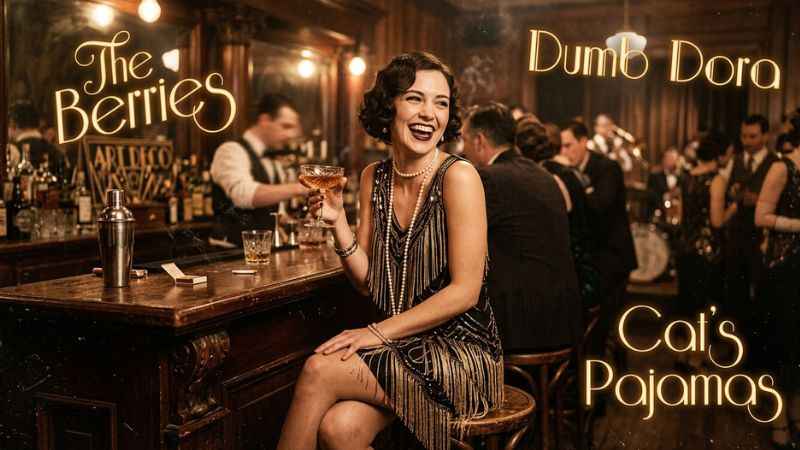
| Year / Stage | Event & Development | Historical Impact |
| 1919 | 18th Amendment Ratified | Banned the manufacture, sale, and transportation of intoxicating liquors across the United States. |
| 1920 | Prohibition Enforcement Begins | Illegal underground bars (speakeasies), bootleggers, and secret jazz clubs exploded in major cities. |
| Mid-1920s | New Secret Dialect Emerges | Partygoers created coded words and slang to talk about illegal drinking without getting caught. |
| Late 1920s | Slang Goes Mainstream | Flapper talk, jazz lingo, and underworld terms spread nationwide through movies, music, and newspapers. |
The 1920s brought huge changes to American life. Cities grew quickly, radios brought music into homes, and young people gained new independence. When the US government banned alcohol in 1920 through Prohibition, illegal bars called speakeasies opened everywhere.
Young people needed new words to talk about hidden parties without getting caught. At the same time, young women called flappers cut their hair, wore short dresses, and threw away old rules. They created a funny, fast-paced way of speaking that spread across the country through movies, music, and newspapers.
Top 10 1920s Slang Terms You Should Know
These ten core terms formed the foundation of 1920s conversational slang:
- Bee’s knees: Something wonderful or high quality. “That new jazz record is the bee’s knees.”
- Cat’s pajamas: An outstanding person or thing. “Look at her dress, it is the cat’s pajamas.”
- Flapper: A stylish, independent young woman of the 1920s. “The flappers danced all night at the club.”
- Speakeasy: An illegal underground bar operating during Prohibition. “You need a password to enter the speakeasy.”
- Giggle water: An alcoholic drink, usually champagne or gin. “Pass me another glass of giggle water.”
- Hooch: Cheap or illegal home-brewed liquor. “The bootlegger brought a fresh batch of hooch.”
- The berries: The absolute best or most delightful thing. “That movie was simply the berries.”
- Jake: Fine, safe, or satisfactory. “Don’t worry about the plan, everything is jake.”
- Applesauce: Nonsense or foolish talk. “Stop telling me those lies, that is pure applesauce.”
- Big cheese: An important or powerful boss. “The big cheese just walked into the office.”
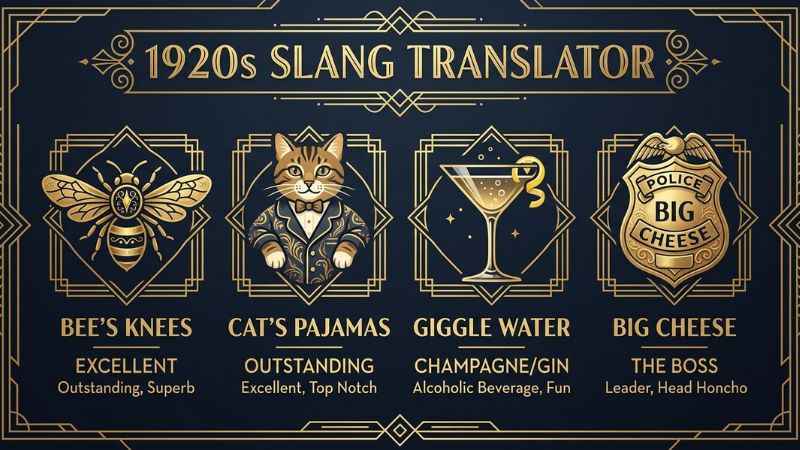
| Term | Meaning | Example Sentence | Still Used Today? |
| Bee’s Knees | Excellent / Great | “His new car is the bee’s knees.” | Yes (as retro slang) |
| Cat’s Pajamas | Outstanding | “She sings like the cat’s pajamas.” | Yes (rarely) |
| Flapper | Modern 1920s woman | “She cut her hair short like a flapper.” | Historical term |
| Speakeasy | Secret illegal bar | “They met behind the shop in a speakeasy.” | Yes (themed bars) |
| Giggle Water | Alcohol | “She had too much giggle water last night.” | Nostalgic use |
| Hooch | Illegal liquor | “Keep that hooch hidden from the police.” | Yes |
| The Berries | Perfect | “A day at the beach would be the berries.” | No |
| Jake | Everything is good | “Tell the boss that the delivery is jake.” | Rare |
| Applesauce | Nonsense | “Oh, applesauce! You don’t know that.” | Very rare |
| Big Cheese | Important boss | “Talk to the big cheese if you want a raise.” | Yes |
1920s Slang by Category (Organized for Real-World Use)
Compliments & Praise
In the 1920s, people loved using silly animal combinations to say something was cool. Calling a person or object the “cat’s pajamas” or the “bee’s knees” meant they had top-tier style.
- The berries: The absolute highest praise for an event or object.
- A real sheik: An attractive, charming man, named after the 1921 Rudolph Valentino film The Sheik.
- Putting on the Ritz: Dressing up in fancy, expensive clothes, named after the luxury Ritz Hotel.
Insults & Put-Downs
1920s insults were playful but clear. If someone was boring, they were called a “flat tire.”
- Dumb Dora: A silly or foolish woman.
- Bent cigar: A bad deal or an untrustworthy person.
- Baloney: Nonsense. People said this when they did not believe a word you said.
- Wet blanket: Someone who ruins everyone else’s fun at a party.
Modern Usage Warning: Terms like “Dumb Dora” carry sexist stereotypes from a hundred years ago. Use them only when writing historical fiction or setting a period scene.
Party & Prohibition Talk
Because drinking alcohol was illegal during Prohibition, partygoers created secret codewords. Speakeasy owners asked guests to “speak easy” (quietly) so neighbors would not hear them.
- Bathtub gin: Cheap alcohol mixed in home tubs.
- Hooch & Giggle water: Popular terms for illicit drinks served at hidden clubs.
- Whoopee: Loud, wild partying. To “make whoopee” meant to throw a huge celebration.
- Bootlegger: A person who smuggled illegal alcohol into cities.
Romance & Dating
Dating changed fast in the 1920s as young people started riding in automobiles without adult chaperones.
- Blind date: A romantic meeting between two people who have never met before. The phrase was first recorded in 1921.
- Carry a torch: To suffer from unrequited love for someone who does not love you back.
- Tomato: A term used by men to describe an attractive woman.
- Neck: To kiss or cuddle in a parked car or dark room.
Money & Status
Money was a huge topic during the economic boom of the Roaring Twenties.
- Mazuma: Cash, greenbacks, or paper money.
- Clams: Dollars. A jacket might cost “ten clams.”
- Rubes: Unwise small-town visitors who got tricked by city scammers.
- Big cheese: The person running the business or holding the wealth.
Everyday Expressions
Some 1920s phrases became household expressions across America.
- Heebie-jeebies: A feeling of extreme nervous anxiety or jitters. Musician Louis Armstrong made the phrase famous in his 1926 song Heebie Jeebies.
- And how!: A strong way to agree with a statement. It means “I completely agree!”
- Tell it to Sweeney: A quick comeback that meant “I don’t believe you, go fool someone else.”
How to Talk Like a Flapper or Sheik (Pronunciation & Usage Tips)
Using 1920s slang today takes a light touch so you sound fun instead of forced.
       [ 1920s Conversation Rules ]
                     │
     ┌───────────────┴───────────────┐
     ▼                               ▼
[ DO THIS ]                     [ AVOID THIS ]
• Drop "g"s at the end         • Overusing terms
• Keep tone high-energy        • Mixing 1900s/1940s words
• Use 1-2 words per sentence   • Stringing 5 terms together
Usage Do’s and Don’ts
Do:
- Use one or two slang words per conversation for emphasis.
- Drop the “g” at the end of words (for example: dancin’, flirtin’).
- Match your body language to your words with bright eyes and energetic gestures.
Don’t:
- String five slang terms together into one unnatural sentence.
- Mix 1920s slang with 1940s WWII slang like “hubba hubba.”
- Use outdated insults in casual modern settings.
Pronunciation Guide
- Speakeasy: Pronounced SPEAK-ee-zee
- Heebie-jeebies: Pronounced HEE-bee JEE-beez
- Mazuma: Pronounced muh-ZOO-muh
- Giggle water: Pronounced GIG-uhl WA-ter
1920s Slang Still Used Today (And Why It Survived)
Many common words in modern English started in the 1920s. These words survived because they were simple, memorable, and filled a gap in everyday speech.
- Blind date: Still the standard term for setting up two strangers.
- Heebie-jeebies: Widely used to describe feeling spooked or nervous.
- Big cheese: Used in modern workplaces to describe top executives.
- Under the counter: Refers to illegal or hidden sales, born directly out of Prohibition rules.
- Fly on the wall: First emerging in print between 1921 and 1927, it describes an unseen observer in a room (though its documentary sense developed later in the 1940s).
These words survived thanks to classic movies, early television, and gangster books that kept the Jazz Age alive in pop culture.
1920s Slang in Pop Culture
The 1920s continue to influence movies, music, and social media today.
- Movies & TV: Films like The Great Gatsby and shows like Boardwalk Empire use authentic slang to make scenes feel real.
- TikTok & Social Media: Retro trends often feature 1920s dance moves and sound clips using phrases like “bee’s knees.”
- Themed Parties: Murder mystery nights and Gatsby galas give people a chance to try out flapper speak in real life.
FAQ: Common Questions About 20’s Lingo
What are some common flapper phrases?
Common flapper phrases include “the bee’s knees” (great), “giggle water” (champagne or gin), “struggle buggy” (the backseat of a car, especially used for romantic encounters), and “handcuff” (an engagement ring).
How do you talk like the 1920s?
To talk like someone from the 1920s, add playful enthusiasm to your voice. Use classic terms like “jake” for okay, replace “nonsense” with “applesauce,” and refer to money as “clams.”
What are some 1920s insults?
Popular 1920s insults include “flat tire” (a dull person), “dumb Dora” (a foolish woman), “wet blanket” (someone who ruins fun), and “go chase yourself” (get lost).
What does “bee’s knees” mean?
“Bee’s knees” means something that is excellent, outstanding, or top quality. People used it to praise great clothes, music, or friends.
What is a flapper?
A flapper was a young woman in the 1920s who wore short skirts, bobbed her hair, listened to jazz, and broke away from traditional social rules.
What did people say instead of “cool” in the 1920s?
Instead of saying “cool,” people in the 1920s said “the cat’s pajamas,” “the bee’s knees,” “the berries,” or “jake.”
What is 1920s slang for alcohol?
1920s slang for alcohol included “giggle water,” “hooch,” “bathtub gin,” “bootleg,” and “panther sweat.”
What are some 1920s slang words for money?
1920s words for money included “mazuma,” “clams,” “cabbage,” “dough,” and “scratch.”
Test Your 1920s Lingo (Mini Quiz)
Try translating these five 1920s sentences into plain modern English:
- “That big cheese drank too much giggle water at the speakeasy.”
- “Stop talking pure applesauce, everything is jake!”
- “Look at that sheik over there, he is the cat’s pajamas.”
- “I cannot spend any clams because I lost all my mazuma.”
- “Don’t bring that wet blanket on our blind date.”
- Answer 1: “That big boss drank too much alcohol at the secret bar.”
- Answer 2: “Stop talking pure nonsense, everything is fine!”
- Answer 3: “Look at that attractive man over there, he is wonderful.”
- Answer 4: “I cannot spend any dollars because I lost all my money.”
- Answer 5: “Don’t bring that boring person on our date with a stranger.”
Sources & Further Reading
- NCTE 2014 Conference Handout: “Slang of the 1920’s” educational resources.
- National Museum of American History: Smithsonian collections on Prohibition history, speakeasy culture, and flapper fashion.
- 1920s Period Newspapers: Primary source archives from The Chicago Tribune and The New York Times (1920–1929).
- Mental Floss & YourDictionary: Historical dictionaries detailing etymology and first-use dates for Jazz Age terms.
What to Do Next
If you are planning a 1920s themed event, pick your three favorite slang terms from the table above and practice using them in conversation today!
You May Also Like:
What Does BOI Mean? All Meanings Explained (Slang, LGBTQ+, Business & More)
YP in 2026: What It Stands For, How YP.com Works, and Whether It’s Still Worth It

Joseph Quinn is the founder and editor of Punspa, a technology-focused website covering technology, website reviews, internet terms, and other things worth figuring out online. He writes and edits the site’s technology and web content, with a focus on clear, useful explanations. He also enjoys humor and wordplay, which occasionally leads him to write a pun-related article just for the fun of it.