ARV meaning is after-repair value. In real estate, it is the estimated market value of a property after planned repairs and renovations are complete. Investors estimate ARV primarily from recently sold, similar homes in comparable finished condition, rather than assuming that a renovation budget will increase a home’s value dollar for dollar.
Key Takeaways
- ARV is a future-value estimate for a property.
- ARV is not current market value, purchase price, repair budget, or a guaranteed sale price.
- A credible ARV begins with closed sales of comparable properties.
What Does ARV Mean in Real Estate?
After-repair value is an estimate of a property’s market value after planned repairs and renovations are complete; it is not a guaranteed future sale price. Buyers can estimate a property’s as-is value, but investors considering renovation commonly also estimate its post-renovation value. They need to know what buyers in that neighborhood pay for homes that are already clean, updated, and ready to move into.
Property values depend on the local market. Location factors and local buyer demand can affect a property’s value even after renovation; the effect should be tested against relevant local market evidence and comparable sales. ARV measures the potential of the real estate after factoring in the neighborhood limits.
What ARV Is and What It Is Not
| Term | What it measures | Common mistake |
| Current market value | Value in the property’s present condition | Treating it as a post-renovation value |
| Renovation cost | What the project costs to complete | Assuming every dollar spent adds a dollar to resale value |
| ARV | Likely market value after planned work is finished | Using it as a guaranteed sale price or profit figure |
| Purchase price | Amount paid to acquire the property | Confusing acquisition cost with future market worth |
| Final sale price | Actual outcome when sold | Expecting the estimated ARV to match the exact final sale number |
Who Uses ARV?
Many different real estate professionals rely on after-repair value to guide their financial choices.
- Home flippers may use ARV as one input when estimating a maximum purchase price and testing projected profitability.
- Buy-and-hold investors use it to plan long-term rental strategies and future refinances.
- Wholesalers use it to present profitable deals to end buyers.
- BRRRR investors may use ARV to model whether a refinance could return some or all of their invested capital, subject to the lender’s appraisal and underwriting.
- Homeowners use it to check whether a major home remodel makes financial sense.
- Some renovation, construction, and investor-focused lenders may consider an as-completed value or ARV alongside total project cost, borrower qualifications, and program-specific underwriting requirements.
How to Calculate ARV Using Sold Comps
The shorthand formula of adding current value to renovation costs is helpful for a quick guess, but the most defensible ARV is built from sold comparable properties matching the home’s expected finished condition.
Step 1: Define the Property’s Finished Condition
Investors must write down the exact post-renovation scope in concrete terms before looking at sales data. The finish level must match the buyer demand in that specific neighborhood. A luxury master suite in a street of starter homes will over-improve the property and waste money.
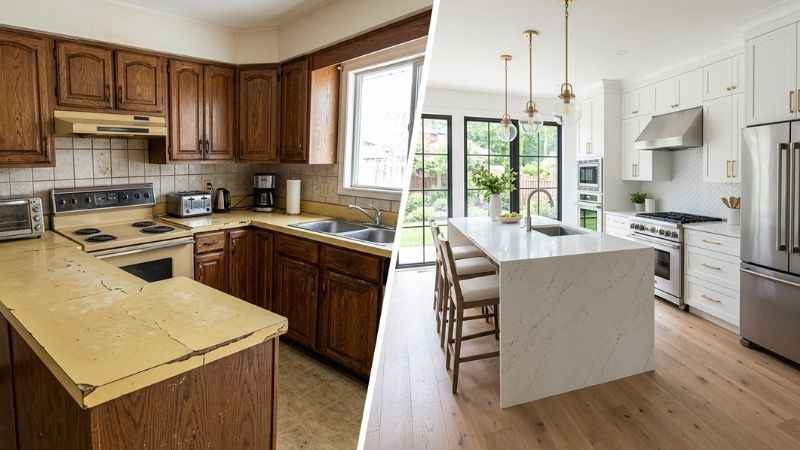
- Kitchen: Cabinets, countertops, appliances, and layout flow.
- Bathrooms: Fixtures, tile work, vanities, and functional count.
- Systems: Roof, HVAC units, plumbing, and electrical panels.
- Finishes: Flooring, interior paint, windows, and trim work.
- Exterior: Siding, landscaping, fencing, and overall curb appeal.
Step 2: Find Relevant Sold Comparable Properties
Closed comparable sales are generally central to estimating value, while active listings, contract sales, and pending sales can provide supporting evidence about current competition and changing market conditions. Matching properties must share a similar micro-location, sale recency, property type, and finished condition.
| Comp category | Strong match | Weak match |
| Status | Favor recent comparable sales, but select the most relevant available sales and account for market changes. If older sales are used, explain their relevance and apply supported market-condition analysis where needed. | Active listing or a sale from over a year ago |
| Location | Use sales that compete in the same relevant buyer market whenever possible. Assess neighborhood, school assignment, road exposure, submarket boundaries, and purchaser behavior using local evidence. | Different submarket across a major highway |
| Condition | Similar completed renovation level | Unrepaired as-is condition or luxury custom finish |
| Property type | Same type and style, such as a single-story ranch | Different buyer profile, such as a high-rise condo |
| Size and layout | Similar square footage and functional room count | Massive size or layout mismatch |
Step 3: Adjust for Meaningful Differences
When comparing properties, analysts consider material differences and should support any adjustments with market evidence; formal appraisals require the appraiser’s judgment and applicable standards. If market evidence shows that a two-car garage contributes more value than a one-car carport for comparable homes in that market, the analyst may make a supported adjustment. Price per square foot can be used as a supplemental comparison metric, but it should not replace analysis of property type, condition, features, and buyer-market differences.
Step 4: Set an ARV Range, Not Just One Number
Future selling prices cannot be known with absolute certainty. Relying on a single precise figure creates dangerous financial risk.
| Scenario | Meaning | When to use |
| Conservative ARV | Lower supported finished-condition value | Offer calculations and risk planning |
| Base-case ARV | Most likely value from strongest market evidence | Core project underwriting |
| Optimistic ARV | High but still defensible outcome | Upside analysis, never the sole basis for an offer |
Step 5: Recheck ARV at Decision Points
Market conditions shift, inventory changes, and buyer demand fluctuates over time. Investors must recheck their ARV figures at several key milestones throughout a project.
- Check the numbers before making an initial purchase offer.
- Re-evaluate after home inspections reveal unexpected hidden damage.
- Review local data before finalizing the construction scope of work.
- Verify the latest sales before refinancing or listing the property for sale.
ARV Formula Explained: Why Repair Cost Is Not Value Added
A common mistake in real estate is assuming that a fifty-thousand-dollar kitchen and bath remodel automatically increases a home’s market value by fifty thousand dollars.
The proper comp-supported ARV model relies on market evidence:
$$\text{ARV} \approx \text{Adjusted value indicated by recently sold, finished-condition comparables}$$
Renovations That Protect Value Versus Create a Premium
Some repairs may be needed to address safety, habitability, code, financing, or insurance requirements, depending on the property, insurer, lender, and local rules. Safety repairs may restore baseline marketability or reduce buyer objections, but whether they generate a measurable premium depends on local market evidence. Cosmetic upgrades improve visual appeal, but they hit a ceiling based on what neighborhood buyers can afford. Major layout changes or an additional bathroom may affect marketability and value when comparable sales demonstrate buyer demand for the resulting configuration.
Worked ARV Example
Consider a hypothetical fix-and-flip project to see how valuation separates from total project costs.
| Deal input | Example amount | What it means |
| As-is purchase price | $\$180,000$ | Acquisition cost, not the after-repair value |
| Planned rehabilitation | $\$55,000$ | Cost required to reach the intended finished condition |
| Three adjusted sold comps | $\$285,000\text{–}\$305,000$ | Market evidence for finished-condition value |
| Base-case ARV | $\$295,000$ | Final comp-supported estimate |
| Potential gross spread | $\$60,000$ | ARV minus purchase price and repair costs only |
| Other project costs | Varies | Financing, holding, closing, selling, and contingency fees |
Adding the purchase price of one hundred eighty thousand dollars to the repair budget of fifty-five thousand dollars gives a total cost of two hundred thirty-five thousand dollars. That figure represents money spent, not the future market value. An estimated ARV of two hundred ninety-five thousand dollars also does not equal sixty thousand dollars in cash profit because holding costs, loan interest, closing fees, and sales commissions still need to be paid.
How Investors Use ARV to Analyze a Deal
Successful real estate investing requires tracking every expense between the initial purchase and the final sale.
Estimated net profit equals the after-repair value minus the sum of the purchase price, repairs, financing fees, holding expenses, closing costs, selling commissions, and contingency reserves.
Deal-Cost Checklist
- Purchase price and acquisition fees
- Repair labor, materials, and contractor bids
- Municipal permits, architectural plans, and engineering fees
- Loan interest, financing points, and lender fees
- Property taxes, hazard insurance, and utility bills during the hold
- Closing costs and sales commissions upon resale
- Emergency contingency reserve for unexpected overruns
What the 70% Rule Means
Many investors use the seventy percent rule as a fast screening tool to evaluate potential deals before doing deep research.
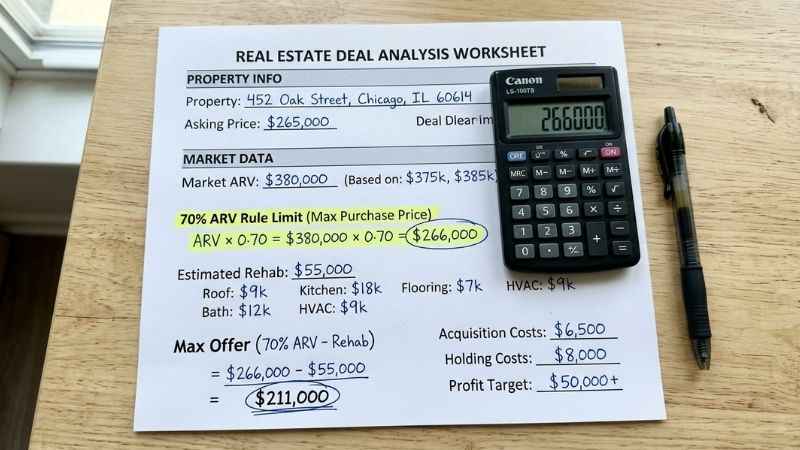
$$\text{Maximum purchase target} = (\text{ARV} \times 0.70) – \text{Estimated repairs}$$
The remaining thirty percent of the value is not pure profit. Under the informal 70% rule, the difference between 70% of ARV and the purchase price/rehab allowance is intended to leave room for costs, risk, and desired profit. Its adequacy depends on the specific deal and should be tested through full underwriting. The seventy percent rule is a quick screen rather than a universal law. Investors commonly adjust their underwriting assumptions for factors such as financing costs, expected hold period, taxes, market conditions, project complexity, and required return; no single ARV percentage works for every transaction.
A Better Alternative: Target-Profit Underwriting
Relying on a rigid percentage formula can cause an investor to miss out on great deals or overpay in expensive markets. A more thorough underwriting model starts with a conservative ARV and subtracts every anticipated non-purchase expense alongside a locked target profit margin to find the maximum safe offer.
$$\text{Maximum offer} = \text{Conservative ARV} – (\text{Repairs} + \text{All non-purchase costs} + \text{Target profit})$$
ARV vs. Appraisal, Market Value, LTV, and ROI
Different real estate metrics serve distinct functions during a property transaction.
| Term | Main question it answers | Timing | Why it matters |
| ARV | What might the property be worth after planned work? | Future, estimated | Deal analysis and renovation planning |
| Current market value | What is the property worth as it stands? | Present | As-is purchase and valuation context |
| Appraised value | What is the value opinion under a formal appraisal? | Assignment-specific | Lender and transaction decisions |
| LTV | How large is a loan relative to value? | Loan underwriting | Borrowing structure and risk limits |
| LTC | How large is a loan relative to total project cost? | Loan underwriting | Construction and rehab funding |
| ROI | What return may the investment generate? | Project-level | Investment performance analysis |
Why an Appraiser May Not Match Your ARV
Appraisers perform assignments under applicable professional standards and assignment conditions; appraisals for federally related transactions are subject to additional regulatory and lender requirements. An appraiser might select different comparable sales, apply stricter condition definitions, or use a more conservative valuation date than an investor. An investor’s calculated ARV never guarantees what a licensed appraiser will write in an official report or what a future retail buyer will pay.
Why a High ARV Can Still Be a Bad Deal
A high after-repair value cannot save a project if the initial purchase price was too high or if construction overruns destroyed the budget. High financing interest, prolonged holding times, and unexpected structural repairs quickly erase anticipated profits. Real estate investors must always balance a strong ARV against total execution risks.
ARV Mistakes That Cause Investors to Overpay
- Using active listings: Do not treat an asking price as equivalent to a completed sale. Active listings can provide supplemental evidence about competing supply, but they should be analyzed separately from closed-sale evidence.
- Comparing mismatched locations: Using sales from another submarket can distort an estimate if the properties do not compete for the same buyers; expand the search only when evidence shows that buyers regard the areas as substitutes.
- Matching wrong finishes: Assuming a luxury renovation level when local buyers only want mid-market finishes leads to wasted capital.
- Treating cost as value: Believing that spending more money on repairs automatically creates an equal dollar increase in resale value.
- Ignoring holding costs: Forgetting to account for monthly utility bills, property taxes, insurance, and loan interest during the renovation timeline.
- Relying on online estimates: Trusting a single automated valuation model or online calculator without verifying local closed sales.
- Skipping downside scenarios: Test one or more downside resale scenarios based on the property’s local market volatility, expected holding period, and investor risk tolerance.
- Skipping professional input: Failing to consult licensed real estate agents, general contractors, or experienced local appraisers before buying a property.
ARV Meaning Outside Real Estate
While real estate dominates search results, the acronym ARV has several other established meanings across different industries.
- Medicine: In healthcare, ARV commonly refers to antiretroviral drugs used to prevent or treat HIV infection. Antiretroviral therapy uses HIV medicines to prevent the virus from multiplying and reduce viral load.
- Retail and Prizes: In promotions and giveaways, ARV commonly means approximate retail value. It is a stated estimated retail value and may differ from a prize’s actual selling price, MSRP, or fair market value. U.S. tax reporting for noncash prizes generally uses fair market value.
- Police and Security: In UK policing, ARV commonly means armed response vehicle: a police vehicle carrying armed officers trained to the ARV standard and adapted to transport specialist equipment and firearms officers to incidents.
- Military and Engineering: In military contexts, ARV can mean armoured recovery vehicle, a vehicle used to recover and support disabled armored vehicles.
Frequently Asked Questions About ARV
What does ARV stand for in real estate?
ARV stands for after-repair value. It represents the estimated market value of a distressed property after all planned renovations and repairs are successfully completed.
Is ARV the same as a home’s sale price?
No, ARV is an educated market estimate calculated from comparable sales. The final sale price is the actual amount a buyer pays when the property sells on the open market.
Does every dollar of renovation spending increase ARV?
No, renovation spending equals construction costs, not market value. Some repairs only fix basic wear and tear without adding extra resale value.
How many comps should I use to estimate ARV?
Most investors aim for three to five strong comparable sales. Quality and proximity matter more than hitting a specific numerical quota of comps.
What does the 70% rule mean in house flipping?
The seventy percent rule is a quick screening guideline stating an investor should pay no more than seventy percent of the ARV minus repair costs. It helps account for holding costs, financing, and profit margins.
Is ARV the same as an appraisal?
An appraisal is a professional opinion of value prepared for a defined assignment purpose. For certain federally related mortgage transactions, the appraisal must be performed by a state-certified or state-licensed appraiser, subject to applicable rules.
Can lenders use ARV when approving a renovation loan?
Some investor-focused and renovation lenders may consider projected as-completed value and total project cost when underwriting, subject to their specific LTV, LTC, appraisal, borrower, and program requirements.
What does ARV mean in prizes or giveaways?
Sponsors may disclose an ARV in contest materials, but U.S. tax treatment of a noncash prize is generally based on fair market value.
What does ARV mean in medicine?
In healthcare, ARV commonly refers to antiretroviral drugs used to prevent or treat HIV infection. Antiretroviral therapy uses HIV medicines to prevent the virus from multiplying and reduce viral load.
What does ARV mean in police or military contexts?
In UK policing, ARV commonly means armed response vehicle: a police vehicle carrying armed officers trained to the ARV standard and adapted to transport specialist equipment and firearms officers to incidents. In military contexts, ARV can mean armoured recovery vehicle, a vehicle used to recover and support disabled armored vehicles.
You May Also Like:
CPO Meaning: Certified Pre-Owned Cars, Chief Product Officer & More
SPH Meaning on an Eye Prescription: Plus, Minus, and Sphere Power Explained

Joseph Quinn is the founder and editor of Punspa, a technology-focused website covering technology, website reviews, internet terms, and other things worth figuring out online. He writes and edits the site’s technology and web content, with a focus on clear, useful explanations. He also enjoys humor and wordplay, which occasionally leads him to write a pun-related article just for the fun of it.