In British git slang, a “git” is a mild insult used to describe an unpleasant, silly, or annoying person. While it sounds like a harsh swear word to non-British speakers, it is actually quite mild. Developers also know the word because Linus Torvalds named his famous code management tool after this exact insult.
Key facts about git:
- Meaning: An annoying, foolish, or rude person (usually a man).
- Severity: Mild insult; less offensive than major profanities.
- Software Link: Named by developer Linus Torvalds as a playful joke about himself.
What does “git” mean in British slang?
In British slang, a “git” is an annoying, foolish, or unpleasant person, usually referring to a man. It is a mild insult that sits between lightweight terms like “idiot” and strong profanities like “wanker.” Friends often use it playfully, though it can show genuine irritation in tense moments.
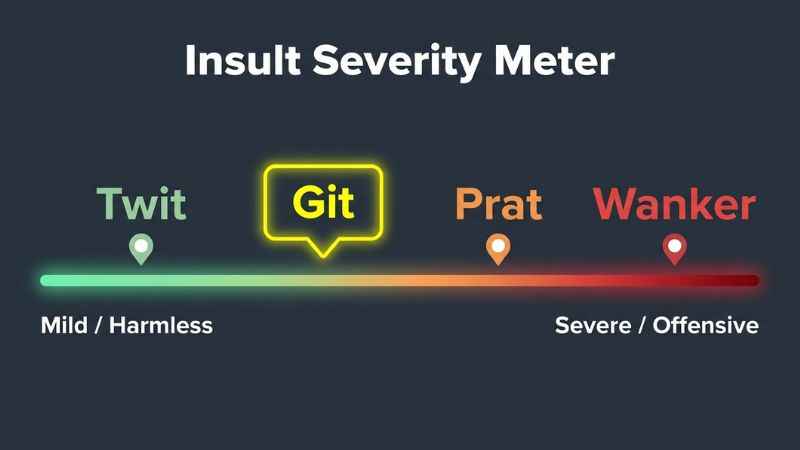
MILD [ Twit / Idiot ] -> [ Git ] -> [ Prat / Berk ] -> [ Wanker / Arsehole ] HARSH
| Insult | Severity | Typical Context | Tone |
| Twit / Idiot | Very Low | Silliness, minor mistakes | Playful / Harmless |
| Git | Mild | Annoying behavior, selfishness | Mildly annoyed / Joking |
| Prat / Berk | Moderate | Foolish or foolishly arrogant acts | Direct criticism |
| Wanker / Arsehole | High | Severe misconduct, hostile behavior | Highly offensive |
Where does “git” come from?
The word “git” comes from the word “get,” which is short for “beget” (meaning to produce children). Historically, calling someone a “get” meant they were a child born out of wedlock, or a bastard. Over time, the spelling shifted to “git” and the meaning softened into a general insult for a fool.
- Etymology: The insult emerges in print around 1946, derived from the earlier dialect “get” (from beget, meaning “offspring”).
- 1900s: The spelling “git” appeared in print around 1946, spreading across the UK after World War II.
- Alternative theory: An old story links the word to British soldiers in World War I mishearing a Turkish phrase. However, lexicographers and standard dictionaries (such as Collins, Merriam-Webster, and Cambridge) trace “get” as the true root.
The variant “get” remains in use in parts of Scotland and northern England.
How do you pronounce “git” (and is “jit” the same)?
You pronounce “git” with a hard G, so it rhymes with “bit” or “sit” (/ɡɪt/). It is never pronounced with a soft J sound (“jit”).
In American slang, “jit” is an entirely different word that often refers to a young, inexperienced kid or delinquent. In computer circles, mixing up “git” and “jit” causes confusion because “JIT” stands for Just-In-Time compilation in coding. Always use a hard G sound when talking about the slang word or the software.
Common phrases and collocations
People rarely use “git” on its own. They usually attach an adjective to show their exact mood or level of frustration.
- Cheeky git: Someone who says bold or mildly rude things in a charming way.
- Lucky git / Jammy git: Someone who achieves success through pure luck.
- Grumpy old git / Miserable old git: An elderly person who complains constantly.
- Stupid git / Lying git: A more direct insult meant to show real anger or annoyance.
Real-world examples:
- “Look at that lucky git—he won the lottery twice!”
- “Don’t listen to him, he’s just being a cheeky git.”
- “My neighbor is a grumpy old git who keeps our lost footballs.”
- “Put that phone down, you stupid git!”
- “He took the last slice of cake, the jammy git.”
Is “git” a swear word?
“Git” is not a swear word, but it is still a pejorative insult. You will not get censored for saying it on daytime television in the UK. However, using it in formal settings like a job interview, court room, or school essay is inappropriate.
When talking with friends, it is usually harmless. In formal settings, stick to neutral language to avoid sounding rude or unprofessional.
Why is the version control system called Git?
Linus Torvalds, the creator of Linux, named his version control software Git in 2005 as a self-deprecating joke, calling himself “a stupid git.”
                                  +--> "Global Information Tracker" (When code works)
                                  |
Linus Torvalds ---> Naming "Git" --+--> "Global Idiot Tracker" (When code breaks)
                                  |
                                  +--> "Stupid Content Tracker" (Official man page)
Torvalds famously stated he named all his projects after himself, first “Linux” and then “Git.” The official documentation for the tool even calls it “the stupid content tracker.”
The “Global Information Tracker” Myth
Many people believe Git stands for “Global Information Tracker.” This is a backronym, which is a made-up explanation created after the name already existed. Torvalds provided funny definitions depending on your mood:
- When it works: Global Information Tracker.
- When it breaks: Global Idiot Tracker.

In 2015, a repository maintainer changed a project description from “WebM for Retards” to “WebM for Gits” following a Terms of Service notification from GitHub, illustrating how slang words intersect with platform moderation. Later, in 2020, developer platform GitHub updated its default primary branch terminology from “master” to “main” to avoid references linked to slavery, highlighting how terminology carries real weight in global tech.
Git in media and culture
The word “git” has been a favorite insult in British pop culture for decades:
- Sitcoms: Popular UK shows like Only Fools and Horses, Blackadder, and Red Dwarf frequently used “git” to bypass television profanity rules while keeping the humor sharp.
- Music: In 1967, American band The Monkees released a song titled “Randy Scouse Git”. Their record company, RCA, required an alternate title for the UK release due to the word being considered rude, so it was issued there under the title “Alternate Title”.
- The Beatles: In the White Album track “I’m So Tired”, John Lennon sings the phrase “stupid get/git,” referencing the traditional northern English pronunciation.
American vs. British usage
While the word is common in the UK and Ireland, most Americans do not use “git” as slang.
- In the UK/Ireland: Everyone knows the word as a mild insult.
- In the USA: Non-programmers rarely hear the word. When Americans do hear it, they often think of the Southern slang word “git” (short for “get out of here”).
- Software Developers: American programmers know the word Git purely as the software tool, often unaware that it is a British insult.
Usage checklist for learners and travelers
| Do | Don’t |
| Do use it in casual, playful chats with British friends. | Don’t use it in professional or formal settings. |
| Do pair it with words like “cheeky” or “lucky.” | Don’t pronounce it with a soft “J” sound (“jit”). |
| Do assume it means a software tool if an American says it. | Don’t assume Americans will understand the slang. |
FAQ: Quick answers to common questions
What does “git” mean in British slang?
It means an annoying, foolish, or unpleasant person. It is usually applied to men.
Is “git” a swear word?
No, it is a mild insult. It is less offensive than terms like “wanker” or “arsehole” and is often used jokingly.
How do you pronounce “git”?
Pronounce it with a hard G, exactly like “get” but with an “i” sound (/ɡɪt/). It rhymes with “bit.”
Is “jit” the same as “git”?
No. “Jit” is American slang for a young or foolish person. “Git” is British slang with a hard G sound.
Where does the word “git” come from?
It comes from the word “get,” short for “beget,” which originally meant an illegitimate child or bastard.
Do Americans use the word “git”?
Americans rarely use “git” as an insult. They mostly know it as the code management software created by Linus Torvalds.
Why is Git software named Git?
Linus Torvalds named it after himself as a joke, referencing the British slang meaning “stupid person.”
Is “Global Information Tracker” the real meaning of Git?
No, that is a backronym created after the tool was named. The name comes directly from the British slang insult.
Next Action for Readers:
If you are learning English or traveling to the UK, practice identifying the tone when you hear the word used in British TV shows. Pay attention to whether the speaker pairs it with a light word like “cheeky” or a harsher word like “stupid” to quickly learn how context changes its severity.
You May Also Like:
Snowflake Meaning Slang: The Complete 2026 Guide (All Contexts Explained)
ATP Meaning Slang: What It Stands For, How to Use It, and When It Means “Answer the Phone”

Joseph Quinn is the founder and editor of Punspa, a technology-focused website covering technology, website reviews, internet terms, and other things worth figuring out online. He writes and edits the site’s technology and web content, with a focus on clear, useful explanations. He also enjoys humor and wordplay, which occasionally leads him to write a pun-related article just for the fun of it.