Mayate literally refers to a beetle in Mexican and Honduran Spanish. In some contexts it may refer specifically to the metallic-green figeater beetle (Cotinis mutabilis), while “June bug” is a looser English approximation and can refer to different beetles. In some Mexican and U.S./Chicano slang contexts, it has pejorative or racist meanings when used about people, so its intended meaning depends heavily on location and context.
Mayate Meanings at a Glance
| Meaning | Typical context | Tone | Practical English translation | Usage guidance |
| Beetle/insect | Mexico and Honduras; nature or everyday speech | Neutral | Figeater beetle; sometimes June bug | Safe when clearly discussing an insect |
| Pejorative sexuality-related slang | Some Mexican contexts | Sensitive / often offensive | Do not use a one-word English equivalent; translate the intended context | Avoid using as a label |
| Racial slur | Some U.S./Chicano slang contexts | Derogatory / racist | Explain rather than reproduce a direct slur | Never use as a label for Black people |
| Possible local/variant meanings | Varies by city, generation, and community | Variable | Context dependent | Verify with a trusted local speaker/source |
The Literal Meaning: A Beetle
Mayate is a common Spanish word used to describe a large beetle. In Mexico and Honduras, mayate can refer to a beetle. In Mexican usage, dictionaries include the metallic-green Cotinis mutabilis among the species called mayate.
While some people translate it as a June bug or June beetle, those English terms can refer to different insects depending on the region. One species often called mayate in Mexican usage is the metallic-green figeater beetle, Cotinis mutabilis. Its documented range extends from the southwestern United States through Mexico and into northern South America.
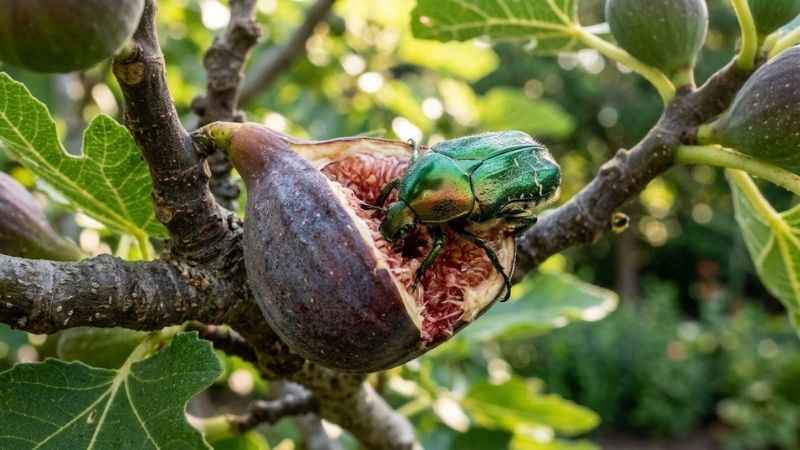
In a nature context, a sentence such as “Había un mayate en el árbol” would normally be understood as referring to a beetle. Depending on the region and the insect intended, it could be translated as “There was a beetle on the tree”; use “figeater beetle” only when the context or source identifies that species. If the context clearly points to nature, gardens, or agriculture, the word carries no negative meaning at all.
Where the Word Comes From
Dictionaries trace mayate to the Nahuatl word mayatl, meaning a kind of beetle. Nahuatl is an Indigenous language spoken in Mexico, with varieties that predate Spanish colonization.
Historical language origins help explain how the literal insect term entered regional Spanish vocabulary. However, etymology does not control modern slang. Indigenous roots do not make later derogatory slang uses neutral or acceptable. Like many words, mayate has developed more than one meaning in different contexts.
Mayate in Mexican Spanish
In Mexican Spanish, the word is a dictionary-recognized word for several beetles in Mexican Spanish, but it also appears in slang dictionaries with very different connotations.
Authoritative dictionaries record Mexican colloquial senses referring to a homosexual man; some sources specify an “active” man in sex between men or a man who prostitutes himself with homosexual men. The exact usage and connotation vary by source and context. This is a context-specific colloquial slang use and may be experienced as derogatory or offensive; it should not be used casually to describe a person.
It is recorded in standard dictionaries as a colloquial or popular Mexican term, but it is sensitive and may be offensive; it is not advisable as a casual descriptor for a person. Dictionary sources differ in how they define and label the term, and its meaning can depend on regional and conversational context. To interpret the word correctly in a conversation, ask yourself a few practical questions. Is the speaker discussing insects, gardens, or fruit? Is the conversation about a person’s identity or dating life? Is the tone teasing, hostile, or purely descriptive? A discussion of gardens, insects, fruit, or animals is more likely to use the literal beetle sense, while a conversation about a person may require careful attention to region, tone, and surrounding language.
Mayate as a Racial Slur
Green’s Dictionary of Slang records a U.S. derogatory sense of mayate for a Black person and traces it to Chicano Spanish; a 1999 Los Angeles Times article also described the word as a denigrating term for African Americans.
This documentation does not mean all Spanish speakers use, know, or endorse the term. Some speakers may encounter mayate primarily in its insect sense, while others may know its slang meanings; usage varies by region and community. Still, because the term has documented sensitive and derogatory uses when applied to people, avoid using it as a label for a person. Its insect use is neutral when that meaning is clear.
When translating an insulting use, make its derogatory force clear rather than rendering it as a neutral term. If the context is unclear, do not assume a neutral meaning. Choose a translation approach appropriate to the format and, for consequential work, consult a qualified translator familiar with the relevant variety of Spanish.
How to Tell Which Meaning Is Intended
Interpreting polysemous words requires a step-by-step context method.
- Identify the setting. Look at whether the sentence appears in a nature discussion, casual street slang, song lyrics, dialogue, or social media commentary.
- Identify the speaker’s region and community context. A discussion of gardens, insects, fruit, or animals is more likely to use the literal beetle sense, while a conversation about a person may require careful attention to region, tone, and surrounding language.
- Look at nearby words and tone instead of translating the word in isolation.
- Choose a translation based on meaning and impact, not merely the closest dictionary equivalent.
Machine translation can miss regional slang and offensive connotations when context is limited. A literal translation may fail to convey slang register or derogatory force when the surrounding context is missing. For high-stakes translation—such as legal, published, academic, or audiovisual work—consider consulting a qualified translator or subject-matter language expert familiar with the relevant regional usage.
Pronunciation, Grammar, and Related Words
In a Spanish-oriented approximation, mayate is pronounced mah-YAH-teh, with stress on the second syllable. A broad IPA transcription is often given as /maˈʝate/; the pronunciation of the y sound varies across Spanish dialects. Pronunciation can vary slightly depending on regional dialects.
Grammatically, dictionary entries list el mayate as a masculine noun for the insect. Do not try to infer social meaning or human characteristics from grammatical gender.
Do not confuse mayate with similar-sounding words. Maya refers to Maya peoples, languages, and cultures, and mayas is its plural form.
Should Spanish Learners Use Mayate?
Spanish learners should exercise caution. Use the word only when you clearly mean the insect and the local context supports that wording. If you want to talk about a beetle in casual conversation, choosing a safer regional alternative or asking a native speaker for guidance prevents accidental misunderstandings.
For the insect, use “figeater beetle” or “green fruit beetle” when Cotinis mutabilis is intended. Use “June beetle” only if the regional insect context supports that broader common name. For people, do not use mayate as a descriptor. For translation tasks, describe the exact connotation, such as labeling a term as derogatory where that is the accurate rendering.
Avoid common mistakes such as assuming every Spanish-speaking country uses the word the same way, translating a sentence without reading the surrounding text, using the term as a joke, or relying on crowdsourced slang sites as your only source of truth.
Frequently Asked Questions About Mayate
What does mayate mean in English?
Mayate can refer to a beetle; in some Mexican contexts, it refers specifically to the figeater beetle (Cotinis mutabilis). Some speakers may use “June bug” loosely, but it is not a precise one-to-one translation because English common names apply to several different beetles.
Is mayate a bad word?
It can be. The literal insect sense is neutral, but some uses involving people are pejorative or derogatory.
Is mayate a racial slur?
Yes, in documented U.S. slang usage associated with Chicano Spanish, it can be a derogatory term for a Black person.
What does mayate mean in Mexico?
In Mexico, it can refer to a beetle; Mexican dictionaries also record sensitive slang meanings.
Does mayate mean June bug?
Some speakers may use “June bug” loosely, but it is not a precise one-to-one translation because English common names apply to several different beetles.
How do you pronounce mayate?
In a Spanish-oriented approximation, mayate is pronounced mah-YAH-teh, with stress on the second syllable.
Can I call someone mayate?
No. Because the word can carry pejorative or racist meanings when applied to people, you should avoid using it as a label.
What is the difference between mayate and Maya?
They are completely different words. Maya refers to the historical and living Maya peoples, languages, and cultures.
What does mayata mean?
[Content removed]
Why do websites give different definitions of mayate?
Different dictionaries and slang resources may describe different regions, registers, and speech communities, which can produce different definitions of the same word.
You May Also Like:
Oscar Mike Meaning: What It Means and How to Use It Correctly
ARV Meaning in Real Estate: How to Estimate After-Repair Value

Joseph Quinn is the founder and editor of Punspa, a technology-focused website covering technology, website reviews, internet terms, and other things worth figuring out online. He writes and edits the site’s technology and web content, with a focus on clear, useful explanations. He also enjoys humor and wordplay, which occasionally leads him to write a pun-related article just for the fun of it.